Fishing • Shade Dragons Fishing
Shade Dragons Fishing: the complete how-to tutorial (halls, special ammo, and disciplined boss windows)
At 6 Club, Shade Dragons Fishing is a real-time shooting arcade: you control a cannon, each shot is a wager, and captures pay back as multipliers. The fun is the control—aiming, timing, and choosing what to shoot. The danger is also the control: you can spend extremely fast if you spray bullets, chase dragons impulsively, or use special ammo on thin waves. This guide teaches a stable, repeatable method that makes the game feel calmer and more predictable.
SEO note: this page is intentionally 3000+ words so it can rank for “Shade Dragons Fishing how to play”, “Shade Dragons Fishing tips”, “Shade Dragons Fishing demo”, and “Shade Dragons Fishing hall strategy”.
What makes it different
Special ammo + hall ladder
Control beats constant fire.
Base rule
Value lane
Shoot clean crossings.
Cost control
Caps
Time/shot/ammo.
Power
Windows
Use at density.
Exit
On schedule
Timer + budget.

Overview: what Shade Dragons Fishing is (in plain language)
Shade Dragons Fishing is a continuous shooter: you fire paid shots at moving sea creatures in an underwater arena. When a target is captured, the game pays a multiplier tied to that target. Because the board never “stops” like a slot spin, it is easy to spend quickly without noticing. That’s why the most important skill is not aim—it’s decision structure.
Players often describe this game as a treasure war. That’s a useful metaphor if you apply it correctly: treasure wars aren’t won by firing nonstop. They are won by choosing battles. In this guide, a “battle” means a short, planned window where you decide to use more power (special ammo, higher focus, a boss attempt). Everything outside that window is calm farming: stable targets, lower pressure, and minimal waste.
The published max win can reach x9000. Treat that number like a volatility warning sign. When a game has a very high ceiling, it usually means there will be many sessions where the ceiling never appears. The only sane response is to play with caps, short windows, and clean exits.
If you follow one idea from this page, follow the loop: farm → window → reset → exit. It is boring. It also works.
Quick facts (fast understanding)
Provider
JDB
Listed on SlotCatalog as a JDB fishing-style shooting arcade.
Release
2023-11-24
SlotCatalog release date for Shade Dragons Fishing.
Max Win
Up to x9000
Very high volatility potential; big moments are not frequent.
RTP
N/A
SlotCatalog lists RTP as N/A; results depend heavily on decisions and variance.
Bet Range
$0.10 – $1 per shot
SlotCatalog attributes list min/max bet; operators can vary UI/limits.
Type
Shooting / Fishing arcade
Every bullet is a paid wager; captures pay multipliers.
Practical note: operators can tweak UI and hall behavior. If your version looks slightly different, the strategy still holds because the core economics don’t change: every shot costs money and the board is always trying to pull you into constant firing.
How to start Shade Dragons Fishing on 6 Club
Beginners usually make one mistake: they treat the game like a reflex test. It isn’t. Shade Dragons Fishing is a budget management game disguised as an action game. Your first sessions should be built around calm repetition so you learn the board and stop feeling urgency.
Find Shade Dragons Fishing under Fishing
Open Our Games → Fishing and select Shade Dragons Fishing. This page is the long-form tutorial behind that game tile, built to teach you how to spend bullets efficiently before you switch to real play.
Pick a hall you can afford to learn in
The game is usually split into halls (Happy Hall, Regal Hall, Five Dragons Hall). Your first goal is not to hunt dragons. Your first goal is to control your spend per minute. Choose the lowest hall where you can practice without feeling rushed.
Set a session timer and a hard budget
Fishing arcades are continuous: there is always another wave. Set a timer (20–30 minutes) and a hard budget. When either ends, you stop. This single habit prevents the most common loss pattern: staying too long and chasing a late boss.
Start with manual bursts
Manual fire teaches the real skill: knowing when to not shoot. Auto features can be useful later, but they can also drain your balance during low-density moments. Begin with short bursts at clean crossings and deliberate pauses.
Pick a value lane
A value lane is the area where you will take most shots—usually the center third of the screen where targets stay visible longest. Lane discipline reduces ‘edge spending’ (shooting at targets that leave immediately) and makes your aim more consistent.
Do one planned ‘power window’ only
Shade Dragons Fishing advertises special ammo (like Shark Cannon rounds and Depth Charges). Treat those as a planned window: you decide in advance when to use them, you cap the attempt, and you return to normal bullets.
Once you can complete a session without breaking your caps, you can start experimenting with higher halls. Until then, staying low is not cowardice—it’s correct training.
Halls and difficulty: Happy Hall vs Regal Hall vs Five Dragons Hall
Halls are not only about stakes—they are about psychology. Higher halls create pressure: larger targets, bigger alerts, and a stronger feeling that you should spend to “keep up.” If you want to play well, you treat halls like training levels. You only move up when you can stay calm.
Happy Hall (learn rhythm and control)
Happy Hall is where you build fundamentals: value lane, shot caps, and calm pacing. When the hall is low stakes, you can observe spawn patterns without panicking. This is the correct place to practice ‘wait, then burst’.
Regal Hall (bigger targets, sharper swings)
Regal Hall is the step up: you’ll often see stronger targets and more pressure to spend. Your job is not to shoot more—it’s to make better shots. If you cannot follow shot caps here, you’re playing too high for your current discipline.
Five Dragons Hall (high variance by design)
Five Dragons Hall is built around big-moment hunting. That can be fun, but it is also where players lose fast because they treat every dragon appearance as mandatory. High halls require strict rules: timed attempts, capped ammo, and clean exits.
Multiplayer vs solo mindset
If you’re on a shared screen, you are competing for screen time and clean angles. In multiplayer, patience becomes more valuable: other cannons clear clutter while you wait for a clean lane. Your goal is not to outshoot; your goal is to be efficient.
A simple test: if you can’t follow a timer and a cap in Happy Hall, you should not be in Five Dragons Hall. Move up only after you can exit cleanly.
Controls and UI: what to focus on while playing
Fishing games overwhelm you with motion, but you only need to track a few things. If you learn to track them, you will naturally spend less.
Cost-per-shot (your real ‘difficulty’ slider)
In a fishing arcade, the real difficulty control is your stake level. Higher levels make every mistake more expensive. Many players lose simply because they raise the level during a hype moment and forget to step back down.
Aim vs spray
Your cannon can be used in two styles: spray (lots of bullets across the screen) or aim (short bursts at specific targets). Spray feels active but often wastes bullets. Aim is slower but more disciplined. This guide teaches the aim-first approach.
Auto features (use as a window)
If your build includes auto-fire or aim assist options, treat them as short windows. Auto should run when density is high and angles are predictable, then stop when the wave thins. Auto during thin waves is the fastest way to drain your bankroll.
Event cues and boss announcements
Dragon/boss cues are designed to spike attention. That doesn’t mean you should always chase. Use cues as a reminder to check your plan: Do you have budget for a boss window today, or are you in a learning session?
Treasure War frame (your decision loop)
Shade Dragons Fishing is often described as a treasure-war style shooter. The most useful way to think about treasure war is a loop: (1) farm stable targets to build rhythm, (2) choose one high-value attempt, (3) reset to farming, (4) exit on schedule.
Why ‘pause’ is a skill
Your best edge is the pause. Every pause is a decision that prevents accidental spending. If you feel rushed, stop shooting for five seconds, re-center your lane, and only then fire again.
The goal of UI awareness is not perfection. It’s preventing accidental behavior, like staying at a high stake after a hype moment or leaving auto features running when the board becomes thin.
Weapons and ammo: how to use power without draining
Shade Dragons Fishing is described as having limited special ammo such as Shark Cannon rounds and Depth Charges. Whether your build labels them exactly like that or uses similar tools, the strategy is the same: treat power as a scarce resource and spend it only when it can hit multiple targets or when a planned boss window is active.
Standard bullets (your baseline)
Most of your session should be on standard bullets. Bullets let you control pacing, build confidence, and learn angles. In high-variance fishing games, ‘boring bullets’ are what keep sessions sustainable.
Shark Cannon rounds (limited powerful ammo)
SlotCatalog mentions a limited stock of Shark Cannon rounds (30 rounds). Treat these like a special resource: you spend them only when the screen is dense or a high-value target is in your lane for long enough. The biggest mistake is firing them just because they exist.
Depth Charges (limited area damage)
Depth Charges (also listed as 30 rounds) are best when density is high. Think of them as ‘crowd control’: you want them to hit multiple targets. Using them on a sparse screen wastes the advantage.
How to budget special ammo
A reliable plan is to reserve special ammo for one window per session. Example: a 10–20 second window in which you use a small portion of the Shark Cannon rounds or a couple of Depth Charges, then you stop and go back to bullets. If you use special ammo all the time, you remove your own safety rails.
The ‘ammo cap’ rule
Even when ammo is powerful, you still need a cap. Decide before you start: ‘I will spend at most X Shark Cannon rounds’ or ‘I will drop at most Y Depth Charges’ in this session. When the cap ends, the window ends.
Why power should follow density
In fishing games, the best moments are dense moments: multiple targets overlapping your lane. That’s when powerful ammo creates value. If the screen is thin, power just increases cost.
If you feel uncertain, return to bullets. Bullets are the control tool. Special ammo is the spice.
Symbols and targets: what you should shoot (and what you should skip)
In fishing games, “symbols” are the creatures and event targets on the screen. Players often assume the best target is the highest payout. In practice, the best target is the one you can capture efficiently within a cap. A mid-tier target that you finish cleanly is often better than a giant dragon that consumes your entire session budget.
| Symbol / Target | Why it matters | How to approach |
|---|---|---|
| Shade Dragons (headline targets) | Shade Dragons represent the ‘big moment’ fantasy of the game. They are tied to the treasure-war theme and are usually what players tunnel on. | Treat dragons as optional. Plan one dragon attempt per session with a timer or ammo cap. If the attempt doesn’t pay inside the cap, rotate back to stable targets. |
| Treasure War / high-value events | Some moments are structured like events: you are expected to shift strategy and spend more aggressively. | Only engage if the screen density supports it and your session plan includes a window. Otherwise, continue farming and let the event pass. |
| Shark / heavy targets | Large targets often have better multipliers but can absorb bullets. They create the ‘I’m close’ trap. | Use timed bursts with shot caps. If the cap ends, you stop. Don’t keep firing because it feels close. |
| Crabs, lobsters, turtles (mid-tier stability) | Mid-tier creatures are often the most practical targets for learning. They pay enough to feel meaningful without requiring huge investment. | Use these to build rhythm. Keep stakes steady, shoot clean lane crossings, and practice strict caps. |
| Small fish (economy targets) | Small fish are the training ground. They let you practice aim and tempo with minimal cost. | Use them to reset after a miss streak. Short bursts only; avoid long sprays. |
| Bonus symbols / multipliers | The game lists multipliers and bonus-related features. Players often overpay trying to ‘force’ a bonus. | Treat bonuses as upside, not a goal. Your primary goal is spending efficiently; bonuses are what happen when efficiency meets luck. |
The healthiest mindset is: your primary job is cost control. When cost control is strong, you are free to enjoy the big moments without turning them into a financial leak.
Core strategy: a repeatable plan that reduces waste
The point of a strategy is not to guarantee wins. It’s to remove unforced errors. This strategy is intentionally simple so you can follow it under pressure.
Default state: don’t shoot
It sounds strange, but the default state in Shade Dragons Fishing should be waiting. You shoot when the angle is clean and the target will remain in your lane long enough. This is how you avoid paying into exits.
Claim a lane and protect it
Pick left/center/right and mostly stay there. Lane play improves your capture rate because you are not constantly re-aiming. It also reduces emotional chasing because you stop reacting to every shiny target.
Use caps for every attempt
Caps are the core of winning discipline. Decide your cap before you fire: a shot count, a time limit, or an ammo limit. If the cap ends, the attempt ends. This is the only consistent defense against high-variance targets.
Farm → window → reset
A sustainable rhythm looks like this: farm stable targets, then take one planned power window (special ammo or a dragon attempt), then reset back to farming. If you stay in power mode permanently, your bankroll becomes fragile.
Downshift after misses
After a miss streak, players tend to speed up and overspend. Do the opposite: lower stakes, shoot only clean crossings for 60–90 seconds, and rebuild confidence. Then decide whether to take a planned window.
Exit on schedule
The real strategy edge is leaving on time. Set a timer and stop when it rings. A clean exit protects you from the late-session chase that wipes out earlier progress.
If your version includes bonus mini-games or special event screens, treat them as extra variance. Enjoy them, but don’t try to force them. Forcing is where overspending starts.
Advanced tips: the habits that matter at higher halls
Advanced play is not about clicking faster. It is about maintaining discipline when the game tries to turn up pressure. These tips are designed to work specifically when you move up halls and the swings feel sharper.
Time-box dragon attempts
If you go for a Shade Dragon, time-box it. Example: 10 seconds or a fixed ammo chunk. Time-boxing is better than ‘until it dies’ because ‘until it dies’ becomes an unlimited spend loop.
Only spend special ammo at peak density
Shark Cannon rounds and Depth Charges are strongest when multiple targets overlap. Wait for the moment the screen is full, then spend. Spending power on a thin screen is just expensive boredom.
Use mid-tier targets to stabilize variance
If you only shoot bosses, your session is all variance. Mix in crabs, lobsters, turtles, and medium fish so you have ‘steady work’ between high-risk windows.
Treat the max win number as a warning
A listed max win of x9000 signals high variance. That means you should expect long stretches without big payouts. Build your plan around surviving those stretches with discipline.
Practice the pause
Every minute, pause for two seconds and check: stake level, lane position, and whether you are currently in a planned window. This prevents ‘accidental high spending’ more effectively than any aiming trick.
Make rules you can actually follow
If your rule is too complex, you’ll break it under pressure. Use simple rules: one boss attempt, one power window, and a hard stop time.
If a tip feels too strict, that’s usually the point. High-variance games punish small leaks.
Practice drills (train discipline fast)
These drills are designed to build automatic habits: lane discipline, caps, and clean exits. You do not need to do them forever. Do them until you notice your spending per minute drops.
Lane-only drill (10 minutes)
For 10 minutes, only shoot targets that cross your lane. Ignore everything else. This trains patience and reduces edge spending.
Shot-cap drill (single target type)
Choose a mid-tier creature category and set a cap (for example: 12 taps). If it doesn’t capture within the cap, stop immediately. Repeat until stopping feels automatic.
Power window drill
Allow exactly one power window in the session. Use a small, fixed amount of special ammo, then stop. The goal is not to ‘win big’; it’s to prove you can end the window cleanly.
Reset drill after misses
After three failed attempts in a row, downshift for 60 seconds: lower stakes, bullets only, clean crossings only. This breaks tilt.
Exit drill
Set an alarm. When it rings, stop within 10 seconds and leave. Do not extend because a dragon appears. This is the skill that separates controlled sessions from chase sessions.
If you only do one drill, do the exit drill. Many players have decent aim. Most players lose because they cannot stop on time.
Multiplayer: how to stay efficient on a shared screen
Multiplayer changes the feel of the game. Targets die faster, lanes are more crowded, and you may feel pressure to shoot constantly. The solution is to shoot less and shoot better.
Don’t race other cannons
When other players are firing nonstop, it can pressure you into the same. That’s a trap. Your goal is a higher ratio of meaningful shots, not a higher shot count.
Avoid expensive windows during chaos
If the board is chaotic (multiple cannons, targets dying fast), prediction is hard. That’s the worst time to use special ammo. Wait for calmer density patterns.
Pick targets others ignore
If everyone is chasing one dragon, you can often do better by farming mid-tier targets in your lane. Consistency beats crowd hype.
Keep lane discipline
Lane discipline matters even more in multiplayer. If you chase across the whole board, you lose track of stake level and waste bullets into exits.
Use other cannons as free clearing. While others spray, you wait for clean crossings. That is how you conserve budget.
Bankroll plans: choose one before you start
A bankroll plan is not about being negative. It’s about making the session predictable. The biggest danger in fishing games is that you keep playing until fatigue makes you chase.
Beginner plan (learning)
20–30 minutes. Lowest hall you can tolerate. Bullets only for the first half. Second half: one power window (small amount of special ammo) with a strict cap. No repeated dragon chasing.
Balanced plan (recreational)
25–40 minutes with a short break. Mostly stable targets with lane discipline. One planned dragon attempt (time-boxed) and one special-ammo window. Exit on time.
High-variance plan (only if you accept swings)
15–25 minutes. Two total windows maximum. Higher halls only if you can follow caps. If the two windows fail, end the session. This plan is strict because variance is harsh.
Stop-loss and stop-win logic
Pick a stop-loss you accept. Consider a stop-win where you bank profit and leave. Many players lose because they keep playing after a win and give it back to one late chase.
Your best plan is the one you will actually follow. Keep it simple.
Common mistakes (and fast fixes)
Mistakes in Shade Dragons Fishing are usually spending mistakes. Fix spending patterns and your aim results often improve automatically.
Holding fire continuously
Continuous fire looks active but is usually the fastest drain. Replace it with short bursts and deliberate pauses.
Using special ammo without density
Special ammo is powerful because it hits hard or hits wide. If the board is thin, special ammo is mostly wasted.
Chasing dragons on impulse
If every dragon becomes an all-in chase, you’ll lose fast. Dragons should be planned windows with strict caps.
Raising stake to recover
Upsizing after losses increases variance and emotion. Downshift instead, rebuild rhythm, and only then decide on a planned window.
Ignoring your exit rule
There is always another wave. Exit on schedule. That’s how you avoid turning an entertainment session into a chase.
Myths: what feels true but usually drains
The UI creates strong feelings: urgency, “I’m close,” “I should use the big gun,” and “I need to keep up.” Use this section as a reset when you feel yourself slipping into chase mode.
“If I keep shooting, it must pay eventually”
Truth
High-variance targets can eat a large budget without paying. ‘Eventually’ is not a strategy; it’s a trap.
Fix
Use shot caps and timers. If the cap ends, rotate.
“Special ammo is always better than bullets”
Truth
Special ammo is better only in the right context (density or high-value windows). Otherwise it simply increases cost.
Fix
Save special ammo for peak density and cap its use.
“Max win x9000 means big wins are common”
Truth
Max win is a ceiling, not an expectation. The bigger the ceiling, the more brutal the variance usually is.
Fix
Build a plan that survives droughts: steady farming + rare windows + clean exits.
“Multiplayer means I must shoot faster”
Truth
Faster shooting with worse aim is the most expensive combination.
Fix
Shoot less, pick a lane, and take clean windows.
Play demo vs play real (what to practice first)
The demo is the safest place to practice your rules. Don’t use it to “prove” you can win. Use it to build habits: lane-only shooting, caps, and ending windows cleanly.
Playable demo
Shade Dragons Fishing demo widget
This embedded demo loads from a third-party widget (FreeDemo). If it doesn’t appear, use the “Play Demo (External)” button to open SlotCatalog in a new tab.
Widget status
Loading
Source: SlotCatalog “Integrate demo game” snippet (slot_id: 34272). This page embeds it for convenience.
If the widget doesn’t load, it can be a region/network restriction. You can still practice effectively by staying in the lowest hall and following the same caps and lane rules.
Images (saved locally for performance)
These screenshots are saved locally so the page loads fast and doesn’t depend on external image servers. They help you recognize UI patterns and understand what the gameplay flow looks like.
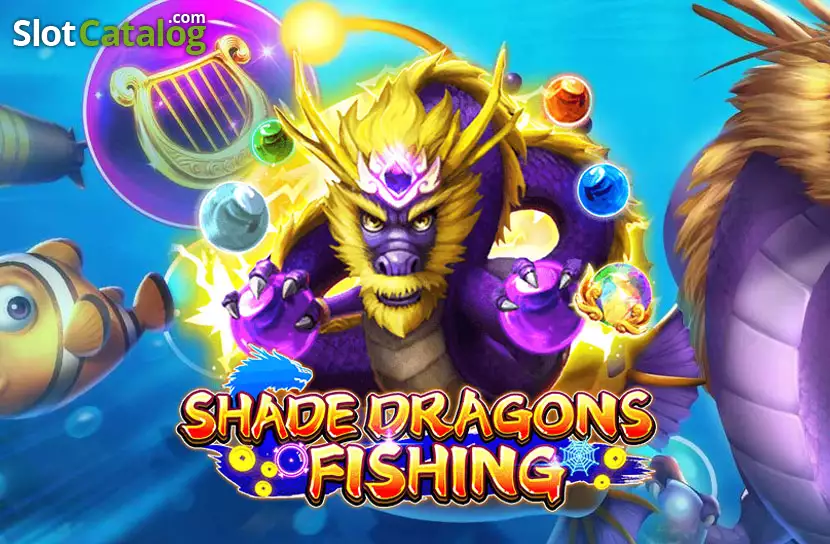
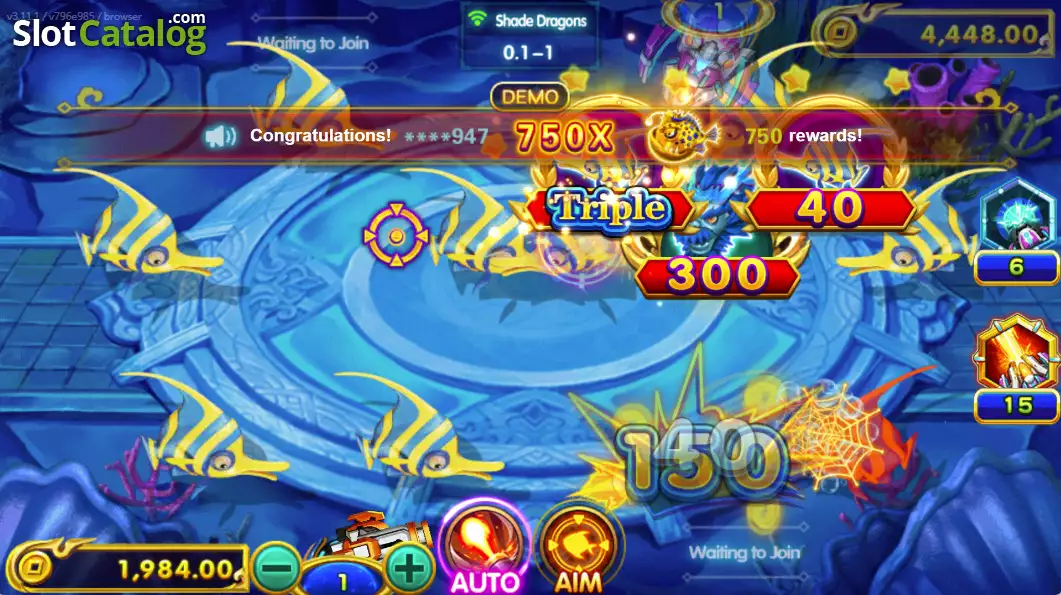
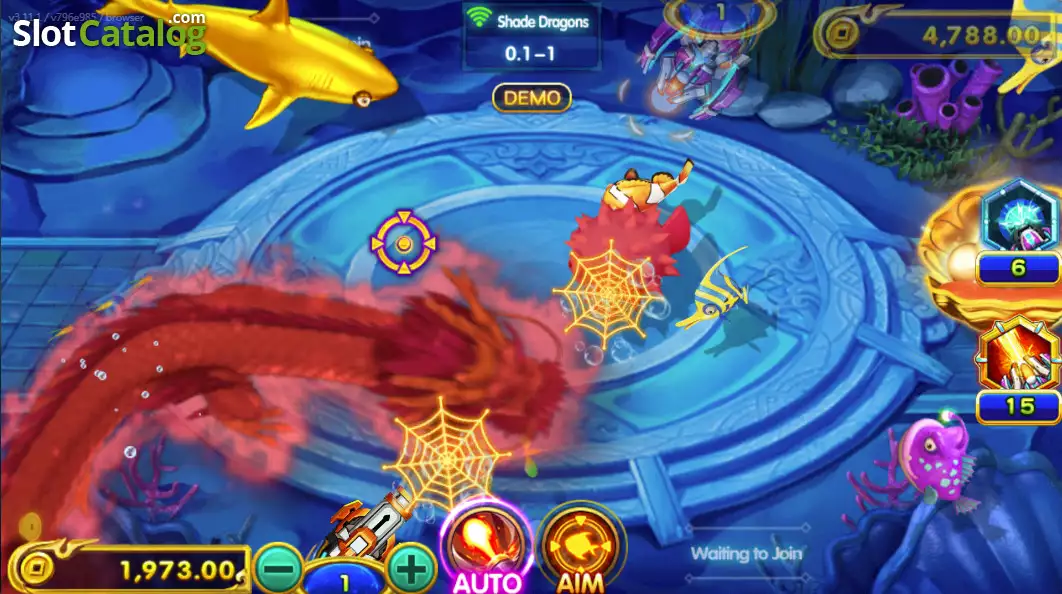
Source: SlotCatalog image gallery for Shade Dragons Fishing (saved locally). Images are used for identification and tutorial context.
Shade Dragons Fishing FAQs
Is Shade Dragons Fishing available on 6 Club?
Shade Dragons Fishing appears in the Fishing category and this page is the full tutorial route. Availability can vary by device/operator, but the guide is designed to match the game’s typical hall + special ammo structure.
Can I play Shade Dragons Fishing for free?
Often yes via a demo widget. This page includes an embedded demo (when available). If the widget is blocked on your network/region, use the external demo link or practice at the lowest stakes with strict caps.
What is the RTP of Shade Dragons Fishing?
SlotCatalog lists RTP as N/A. In fishing arcades, results are heavily influenced by decisions and variance, so your personal results can swing widely.
What do the halls mean (Happy/Regal/Five Dragons)?
They represent different risk and pacing expectations. Higher halls typically mean higher volatility and pressure to spend. Start low until you can follow shot caps consistently.
How do I use Shark Cannon rounds and Depth Charges?
Use them in a planned window when density is high. Cap usage. Avoid using special ammo on a thin board.
What’s the best beginner strategy?
Pick a lane, use short bursts, apply shot caps, farm mid-tier targets, and do only one planned high-value attempt. Exit on schedule.
Why do I spend so fast in fishing games?
Because the game is continuous and it’s easy to hold fire. Switching to bursts, setting caps, and pausing deliberately reduces spend drastically.
Is Shade Dragons Fishing skill-based?
It’s a mix. Skill improves efficiency (lane discipline, timing special ammo, stopping on time), but captures and high-value events still involve randomness.
Is it safe and responsible to play?
It’s a real-money gaming experience with genuine risk. Set limits, avoid chasing losses, and stop if it stops being fun. Seek support resources in your region if play feels compulsive.
Want more fishing guides? Browse Fishing games.