Fishing • Jackpot Fishing
Jackpot Fishing: the complete how-to tutorial (weapons, jackpots, and discipline)
At 6 Club, Jackpot Fishing is a fast-paced aim-and-shoot fishing game where every shot is a wager. The twist is weapon choice: you can stay on bullets for stable control, lock a target with a laser, fire higher-impact torpedoes, pay for freeze, and build an electric meter for a wide-area blast. This guide teaches the game step by step, explains what the symbols/targets mean, and gives practical tips that reduce wasted shots.
Depth note: this page intentionally targets 3000+ words so it can rank for queries like “how to play Jackpot Fishing”, “Jackpot Fishing tips”, “Jackpot Fishing weapons”, and “Jackpot Fishing demo”.
What makes it different
Weapons + meter + jackpots
The best results come from controlling tool usage, not from nonstop firing.
Base rule
Value lane
Shoot center crossings.
Cost control
Shot caps
Rotate when cap ends.
Tools
Short windows
Torpedo/freeze on plan.
Exit skill
Stop cleanly
Timer + stop-loss.
Overview: what Jackpot Fishing is (in plain language)
Jackpot Fishing (Jili Games) is a fishing-style arcade game where you control a cannon and spend shots to try to defeat fish and sea creatures. When a target is defeated, you receive a payout tied to that target’s value. Unlike slots where a single click resolves a spin, fishing games are continuous: you make dozens of micro-decisions per minute.
That continuous control is both the fun and the danger. Fun, because your aim, timing, and tool use matter. Dangerous, because you can also spend extremely fast if you hold fire, chase targets off-screen, or treat expensive tools as toys. This guide is built to prevent those leaks with repeatable habits: value lane, shot caps, and scheduled windows.
Jackpot Fishing adds extra intensity through weapon choice and jackpots. You can stay on normal bullets and play a calm, controlled style, or you can switch to lock laser and torpedoes to hunt larger targets. The correct question is not “which weapon is best?” It is “which weapon is best for this exact moment, given my budget and the screen density?”
Quick facts (for fast understanding)
Provider
Jili Games
SlotCatalog lists Jackpot Fishing as a Jili title
RTP
97%
Listed as top-tier RTP; real returns depend on play style and operator settings
Max win
Up to 888x on a single target
Progressive jackpots can exceed this
Game type
Fishing / shoot-'em-up
Each shot is a wager; captures pay back
Core twist
Weapon switching
Bullets, target laser, torpedoes, freeze, and electric blast
Multiplayer
Shared screen
Up to 3 cannons; spacing and timing matter
Important: some details (bet range, jackpot qualification) can vary by operator and region. The strategy in this tutorial is designed to work even when your build uses slightly different menus or names, because the underlying problem is the same: spending bullets efficiently.
How to start Jackpot Fishing on 6 Club
If you are new to fishing games, Jackpot Fishing can feel overwhelming because targets move continuously and the screen is often crowded. The goal for your first sessions is not to chase the biggest fish. The goal is to learn the flow: where targets cross, how often waves repeat, and how quickly your budget disappears when you stop aiming.
Open Jackpot Fishing from the Fishing category
In 6 Club, go to Our Games → Fishing and select Jackpot Fishing. The Fishing gallery tile is driven by your local thumbnail (jackpot fishing.webp), and this page exists so that tile routes to a full tutorial.
Choose a comfortable room or stake level
If multiple rooms are available, start where the stake-per-shot is small enough that you can take your time. Jackpot Fishing is high-tempo; the best learning happens when you are not rushing your aim.
Set a short practice timer
Treat the first sessions as practice, not a test of courage. A 20–30 minute timer is long enough to see waves, try weapons, and learn the meter, without drifting into fatigue.
Start with bullets and tap rhythm
Begin with the default weapon and a tap cadence (short bursts) instead of holding fire. You want feedback: angle, travel, and hit confirmation. Tap rhythm gives you control and reduces wasted shots.
Only switch weapons with a reason
Weapon switching is the main feature, but it’s also the main leak. You will use torpedoes, freeze, and the electric blast when the screen density supports it—not as a reflex.
End on schedule
The end is part of the skill. When your timer or budget ends, stop even if a boss arrives. This single habit protects bankroll more than any aiming trick.
The simplest mindset shift is this: in a fishing game, shooting is not the default state. Waiting is the default state. You shoot only when the angle is good. When you accept that, everything becomes calmer.
Controls and UI: what to look at while playing
Great fishing play is mostly attention management. The screen is busy, but you only need to track a few things: your cost-per-shot, the weapon mode you are in, the electric meter charge, and whether the current screen is dense enough to justify expensive actions.
Your cannon, your cost-per-shot
In Jackpot Fishing, every bullet you fire costs money. The displayed bet level is effectively your stake per shot. Learning happens fastest when you can stay calm, so start low and treat higher levels as short windows—not a permanent setting.
Weapon stack (right side)
A key part of Jackpot Fishing is the weapon menu. You can switch from basic bullets to a target laser or torpedoes, and you can activate tools like freeze. The important concept is that each option changes both cost and efficiency. Your job is to switch only when it buys you better efficiency.
Electric meter (bottom-left)
The electric meter charges as you shoot. When full, you can unleash a wide-area electric blast that affects many fish at once. This is one of the best tools in the game, but only when fish density is high in the lane you can reliably cover.
Jackpot display and critical-hit framing
Jackpot Fishing can feature jackpots tied to specific high-value targets. The UI can make jackpot targets feel urgent. Treat that urgency as a design feature, not a signal. You will decide in advance whether you have budget for a jackpot attempt.
Shared screen signals
If other players share the screen, you may see multiple cannons and overlapping fire. This increases chaos and reduces accuracy. The fix is not to shoot faster—it is to claim a zone, shoot cleaner angles, and wait for your windows.
Paytable and target information
Use the paytable to understand what categories exist (normal fish, gold fish, special fish, effect fish, kings, jackpot fish/dragons). You don’t need to memorize every number. You need a decision rule: which targets you shoot at base, which you budget for, and which you skip.
A useful habit is to do a five-second “dashboard check” every minute: look at your weapon mode, look at meter charge, look at your stake level, and then decide whether you are in a low-cost learning mode or a high-cost attack window. Most bankroll leaks happen when players forget they switched into an expensive mode.
Weapons and tools: how to use them without overspending
Jackpot Fishing rewards players who treat tools as scheduled windows. If you flip tools on and off impulsively, you get the worst of both worlds: higher costs and lower accuracy. The sections below explain each tool with an “intended use” and a “common misuse” so you can self-correct quickly.
Bullets (default)
Bullets are your baseline: low complexity, stable pacing, and the easiest tool for learning angles. Use bullets for warm-ups, for normal fish, and for most of your session time. The best long-term players treat bullets as the foundation and use the fancy tools as short bursts.
Target laser (continuous lock)
A target/laser mode can lock onto a specific fish and fire continuously while it is present. This can reduce aim workload, but it can also spend too fast if you do not control the duration. The safest way to use it is with a timer: lock, count 2–4 seconds, then stop and reassess.
Torpedoes (higher cost, higher impact)
Torpedoes typically cost multiple times your base shot cost and can travel through clutter more cleanly. Use them when bullets are being blocked by other fish or when you have a short, high-value attempt planned. If you use torpedoes without a shot cap, they will consume budget faster than anything else.
Auto fishing (automation)
Automation can be helpful for repetitive tasks or for holding a target while you watch the meter. The risk is that automation keeps shooting during low-quality angles. If you use it, pair it with strict rules: only run it during dense windows, and stop it the moment density breaks.
Freeze (expensive but powerful)
Freeze can stop or slow the screen so you can finish targets and line up multi-kills. Because freeze has a big cost multiplier, it is not a ‘use often’ tool. It is a ‘use only when it turns chaos into efficiency’ tool—typically when multiple valuable targets overlap.
Electric blast (meter ability)
The electric blast is your best crowd-control tool when density is high. Treat it like a mini-event: you prepare for it, you wait for the right overlap, and then you trigger it. If you trigger it on a scattered screen, you waste the charge.
If you remember just one thing: bullets are your base, and everything else is a limited-time upgrade. This framing makes your sessions stable.
Targets, symbols, and payouts (what the fish mean)
Fishing games use “symbols” differently than slots. In slots, symbols are static icons that combine on reels. In fishing, symbols are target types. Jackpot Fishing includes normal fish, golden fish, special fish with higher swing, effect fish that modify the screen, large kings, and jackpot-themed targets.
The exact numbers depend on your build, but SlotCatalog’s paytable summary describes ranges such as normal fish paying roughly 2x–35x, golden fish around 50x–60x, effect fish around 70x–110x, a treasure bowl up to 888x, and jackpot targets with both fixed multipliers and jackpot potential. You don’t need to memorize the full table; you need to build a shot plan by category.
Normal fish (low payout, high control)
Normal fish pay smaller multipliers, but they are vital for stabilizing a session. You use them to keep your rhythm, to avoid tilt after misses, and to recharge meter without expensive tools. In the long run, normal fish are what make your sessions sustainable.
Golden fish (simple, higher multipliers)
Golden fish are the step up: a clear jump in payout with a corresponding increase in required shots. These are often good ‘structured targets’—you can plan a fixed number of shots, then stop. They are less chaotic than chasing bosses.
Special fish (range payouts)
Some special fish can pay within a lower range most of the time, and occasionally pay within a much higher range. That ‘two-range’ behavior is where many players overspend. Your counter is discipline: decide whether you are hunting the high range today, and cap the attempt.
Effect fish (modifiers)
Effect fish are valuable because they can do more than pay a multiplier—they can change the board. Examples include chain lightning, spawned torpedoes, or vortex-style pulls. Your best habit is to treat effect fish as ‘setup’ targets: defeat them when the follow-up board is dense enough to benefit.
Immortal kings (partial value)
Large ‘king’ targets can sometimes award value even if you do not fully defeat them. That tempts players into nonstop firing. The correct approach is still budget-first: take the value you planned to take, then stop.
Jackpot fish and jackpot dragon
Jackpot targets are the headline. They can pay fixed multipliers or trigger jackpots. They are also the most variance-heavy part of the game. Treat them like a scheduled boss window: one attempt, with a defined budget, then back to normal play.
Practical decision table
| Target category | Default weapon | When to shoot | Hard rule (cap) |
|---|---|---|---|
| Normal fish | Bullets | Warm-up, rebuild rhythm, refill meter safely | 3–6 taps, then rotate |
| Golden fish | Bullets or short laser | Clean lane crossings with enough on-screen time | 12–20 taps; no chasing exits |
| Special fish | Bullets → brief tool window | Only when screen is calm and you can commit | Fixed budget; stop when used |
| Effect fish | Bullets (focus) | When follow-up density is likely in your lane | Prioritize, but do not chase off-screen |
| Kings / large bosses | Planned torpedo/laser | Only as a scheduled boss window | One attempt per session |
| Jackpot targets | Preplanned tool stack | Only if you qualify and budgeted it | Short window, then exit |
This table is intentionally conservative. Conservative play is what lets you play longer, learn more, and avoid the most common failure mode in fishing games: spending too quickly to enjoy the session.
Jackpots and critical hits: how to treat them like a planned event
Jackpot Fishing’s jackpot layer is the reason many players search for this game. It is also the reason many players overspend. The correct way to approach jackpots is the same way a disciplined player approaches a boss wave in other fishing titles: as a planned event with a fixed budget.
Understand what jackpots do to your decision-making
A jackpot mechanic increases psychological pressure. The UI can make it feel like you are ‘supposed’ to shoot jackpot targets whenever they appear. Good play is the opposite: you decide in advance whether your session includes a jackpot attempt.
Qualification and minimums (operator-dependent)
Some builds require a minimum coin/stake level to qualify for certain jackpot chances. If you are below that minimum, chasing jackpot targets becomes all cost and no upside. Always verify qualification rules in the paytable or game info.
Budgeted jackpot windows
If you take a jackpot shot at all, do it as a short window. A useful rule is to set a fixed cap in shots or in total spend (for example: ‘one freeze + 20 seconds of torpedoes’). When the cap ends, your window ends.
Why the max win number matters
SlotCatalog lists a max win of 888x on a single target, while progressive jackpots can go higher. The takeaway is not ‘how to force 888x’. The takeaway is variance: high multipliers come with long droughts. Your bankroll plan must assume that droughts happen.
A practical approach is to decide your “jackpot participation” before you start: either today is a learning session (no jackpots), or today includes one jackpot attempt window. When you decide in advance, you remove the emotional decision.
Core strategy: the simple rules that prevent bankroll leaks
If you are overwhelmed, this section is your anchor. You do not need complex theory to play Jackpot Fishing better. You need a few rules that you can follow even when the screen looks chaotic.
Pick a base plan: 80% bullets, 20% windows
Start every session with a default plan: most of your shots are cheap and controlled (bullets), and a smaller portion is reserved for tools and boss-like attempts (torpedoes, freeze, electric blast). If you invert this, your session becomes expensive instantly.
Claim a value lane
Choose the lane you will treat as your ‘value lane’—usually the center third of the screen where targets stay visible longest. You will mostly shoot targets that cross your value lane. This single rule removes half of the chaos.
Use shot caps
Before you fire at a target, decide your cap. Example caps: small fish 3–6 taps, medium targets 8–14 taps, high-value targets 20–40 taps, jackpot windows a fixed ‘tool budget’ (such as one freeze + limited torpedoes). If the cap ends, you rotate.
Prefer overlaps over chases
Your efficiency rises when multiple targets overlap your aim path. If targets are scattered, you wait. If targets overlap in your lane, you engage. This makes the electric blast and freeze dramatically more effective.
Stop on schedule
Jackpot Fishing is designed to keep you firing. Your best edge is the exit. Set a timer and a stop-loss. If either hits, leave the room. A clean exit is a winning skill.
The best shortcut is to treat every tool as a “budgeted window.” If you can’t tell yourself when the window ends, you don’t have a window—you have a leak.
Advanced tips and tricks (still grounded and practical)
These are higher-level habits that help once you already understand lane selection and shot caps. None of them require perfect reflexes. They require restraint.
Torpedo rule: only when bullets are blocked
If your bullets are consistently being blocked by other fish or clutter, torpedoes can be justified. If bullets have clear lines, torpedoes are usually a waste. This one rule prevents the most expensive misuse.
Freeze rule: buy time for a multi-target finish
Freeze is not a ‘help me aim’ button; it’s a ‘convert density into guaranteed coverage’ button. Use it when you can finish multiple valuable targets or secure a jackpot window. Skip it when the screen is sparse.
Electric blast rule: trigger at peak density
The meter is valuable because it is earned. Don’t spend a full meter on a scattered screen. Wait for a school, a cluster, or a boss entourage to cross the lane you can cover reliably.
Target laser rule: keep a countdown
Because laser lock can keep firing, it is easy to overspend without noticing. Use a countdown (2–4 seconds), then release and reassess. You want controlled bursts, not continuous drain.
Reset rule after misses
After a miss streak, step down to bullets only for 60–90 seconds. Shoot only clean center crossings. This ‘reset block’ breaks tilt and restores aim.
One jackpot attempt per session
If you are going to chase a jackpot target, do it once per session. Multiple attempts turn into a slow bleed. Your long-term health comes from limiting exposure to high-variance windows.
Multiplayer chaos is a signal to slow down
When two or three cannons are active, targets disappear faster and angles are noisier. Counterintuitively, your best move is to shoot less, not more. Wait for your lane, then take clean shots.
Notice that most “tips” are actually rules that prevent overspending. That’s not an accident. In fishing games, the biggest difference between a fun session and an expensive session is how often you say no.
Practice drills (build real skill without raising risk)
A good drill has three properties: it is short, it is specific, and it produces a yes/no result. The drills below are designed to be repeatable and to create measurable improvement in aim discipline.
10-minute aim calibration
Use bullets only. For 10 minutes, shoot only center crossings and stop shooting whenever targets are on the outer edges. This drill trains patience and reduces wasted shots.
Shot-cap discipline
Pick one medium target type and practice strict caps. Example: 12 taps max. If it doesn’t finish, you rotate immediately. Repeat until leaving feels automatic.
Meter timing
Build the electric meter with bullets. Then wait for a cluster before triggering. The goal is not to trigger quickly; the goal is to trigger correctly. Log whether your blast hit 1–2 targets or 5–8 targets.
Freeze value test
In one controlled session, allow yourself exactly one freeze. Use it only when there are multiple high-value targets in your lane. If you cannot find such a moment, skip freeze entirely. This teaches selection.
Torpedo window
Allow yourself a short torpedo window (for example 10 seconds) when bullets are blocked. End the window even if you feel ‘close’ to a finish. This trains restraint.
If you do only one drill, do shot-cap discipline. Most players know what a cap is, but they don’t practice obeying it. Practicing obedience is what makes you consistent.
Bankroll plans (templates you can copy)
Jackpot Fishing is more intense than many fishing titles because tools and jackpots can speed up spending. A bankroll plan protects you from the exact moments when you feel tempted to spend faster.
Starter bankroll plan (learning phase)
Session length 20–30 minutes. Bullets only for the first 10 minutes. In the second half, allow one tool window (either electric blast or a short torpedo burst). Skip jackpots. The goal is to learn pacing and lane selection, not to prove anything.
Balanced plan (recreational play)
Session length 25–40 minutes with a 5-minute break after 20 minutes. Bullets for most shots, with two planned windows: one meter blast and one limited weapon switch. One jackpot attempt maximum, only if you set a strict spend cap.
High-variance plan (only if you accept swings)
Short sessions (15–25 minutes). Two windows total: one freeze window and one jackpot attempt window. If either window fails to pay within the budget, end the session. This plan is risky and only suited for players who already have discipline.
Stop-loss and stop-win logic
Pick a stop-loss you can accept (for example 15–20% of your session budget). Optionally set a stop-win (bank a portion of profit). The most common error is ignoring the stop-win and giving profit back to a late jackpot chase.
The most valuable rule in this entire tutorial is the exit rule: stop on schedule. If you do that consistently, you can enjoy the best parts of Jackpot Fishing without letting the high-energy design control your wallet.
Multiplayer etiquette and screen management
Jackpot Fishing can be played on shared screens where more than one cannon is active. This changes the game. It becomes easier to feel rushed and harder to land clean shots. The solution is not to fight the chaos; the solution is to create structure inside the chaos.
Claim a zone and stay in it
On a shared screen, your accuracy drops when you chase targets across the entire board. Pick a zone (left, center, right) and prioritize targets crossing your zone. This reduces overlap conflict and wasted shots.
Do not race other cannons
When another cannon is firing, it can tempt you to fire faster. That’s a trap. Faster shooting with worse aim is the most expensive combination. Your edge is selecting better angles, not clicking faster.
Avoid expensive tools during chaos
Freeze and torpedoes are most valuable when you can predict outcomes. When the screen is chaotic, prediction is hardest. Save expensive tools for calmer windows with clear density.
Use the demo to practice multiplayer pacing
If the demo shows other cannons, use it to practice lane discipline. The objective is to feel comfortable waiting while other cannons spray.
Many players lose money in multiplayer screens because they fire at targets that are already being focused by another cannon. A calmer approach is often more efficient: shoot targets that cross your lane and that other cannons are not already deleting.
Mistakes to avoid (the fastest fixes)
If you feel like Jackpot Fishing “eats your balance,” it is almost always one of these mistakes. Fixing them is a bigger improvement than learning any advanced trick.
Holding fire as a default
Continuous fire feels productive but usually wastes budget. Tap, aim, and pause. Every pause is a decision that saves money.
Switching weapons without a plan
Weapon switching is powerful, but it should be rare. If you can’t answer ‘why am I switching right now?’, you should not switch.
Using freeze on a sparse board
Freeze is expensive. If there are only one or two low-value targets, freezing is almost never worth it.
Triggering electric blast too early
A full meter is valuable. If you trigger it immediately, you often hit too few targets. Wait for density.
Chasing jackpot targets late in session
Late-session jackpot chases are driven by fatigue and emotion. Your hands speed up, aim gets worse, and budget disappears. If you want a jackpot attempt, schedule it early, not late.
Raising stake to recover
Upsizing after losses increases variance and makes recovery harder. Step down to bullets and do a reset block instead.
Myths (what players believe vs what actually helps)
‘More expensive weapons guarantee bigger wins’
Truth: More expensive weapons increase speed and impact, but they also increase spend. Without density and shot caps, they simply drain faster.
Fix: Use bullets as default; use torpedoes/freeze only during planned windows with caps.
‘If a jackpot target appears, you must shoot it’
Truth: Jackpot targets are designed to trigger urgency. Urgency is not opportunity.
Fix: Decide in advance whether your session includes a jackpot window; otherwise skip.
‘The electric blast should be used immediately when ready’
Truth: Immediate use often hits too few targets to justify the charge.
Fix: Hold the blast until a cluster crosses your value lane.
‘Auto fishing saves money because it aims for you’
Truth: Automation can keep firing during low-quality angles and overspend.
Fix: If you use auto, use it only for short dense windows and stop it quickly.
‘Skill means you can beat RTP’
Truth: Skill improves efficiency, but outcomes still involve randomness and the house edge exists.
Fix: Play for entertainment, follow bankroll rules, and treat streaks as normal variance.
Jackpot Fishing’s graphics and pace are designed to make everything feel urgent. Your job is to slow the game down with rules. That is what turns a chaotic screen into a controllable one.
Play demo vs play real
If your platform provides a demo, it is the best place to practice the value lane rule, weapon windows, and the electric meter timing without risking your budget. If demo is restricted in your region, you can still create a demo-like environment by using minimum stakes, a short timer, and strict caps.
Playable demo
This embedded demo loads from a third-party widget (FreeDemo). If it doesn’t appear, use the Play Demo button to open the demo in a new tab.
Tip: use demo time to practice obeying caps, not to chase jackpots. If you can obey caps in demo, you can obey caps in real play.
Video (from SlotCatalog)
SlotCatalog maintains a “Video and Image gallery” section for Jackpot Fishing. If you want to watch gameplay footage or browse the full gallery beyond the screenshots stored locally on this page, use the link below.
Note: video availability can vary by region and may require age verification on SlotCatalog.
Jackpot Fishing FAQs
Is Jackpot Fishing available on 6 Club?
Yes—this page is part of the 6 Club Fishing category. Availability can vary by device/platform, but the route exists for the Fishing gallery and for the full tutorial.
Can I play Jackpot Fishing for free?
Often yes, via a demo mode depending on your platform/operator. This page includes an embedded demo widget when available. If demo is not available in your region, practice with minimum stakes and strict shot caps.
What is the RTP of Jackpot Fishing?
SlotCatalog lists a 97% RTP. In fishing-style games, actual results depend heavily on decisions (what you shoot and how fast you spend). Less efficient play can feel like a lower RTP.
Is Jackpot Fishing skill-based or luck-based?
It is a mix. Skill affects efficiency: lane selection, shot caps, and when you use tools. But captures still involve randomness, and jackpots are high-variance outcomes.
What is the safest weapon to use?
Default bullets are the safest because they let you control pace and cost. Use other weapons as short, planned windows rather than a permanent mode.
When should I use freeze?
Use freeze only when it converts chaos into value—typically when multiple high-value targets overlap and you can finish them. Avoid freezing sparse boards.
How do I stop spending too fast?
Use a tap rhythm, claim a value lane, set shot caps per target, and schedule tool windows. If you feel rushed, step down, pause shooting for 10 seconds, or end the session.
Do jackpots require a minimum bet?
Some builds require minimum coin/stake levels to qualify for certain jackpot chances. Check your in-game rules/paytable for the exact requirement in your version.
Images and visuals (symbols, UI, and real screenshots)
Below are locally hosted visuals for faster loading: original SVG diagrams that explain the UI and decision model, plus a small set of real screenshots saved from SlotCatalog’s image gallery. We keep this section visual so you can understand the layout before you start firing.





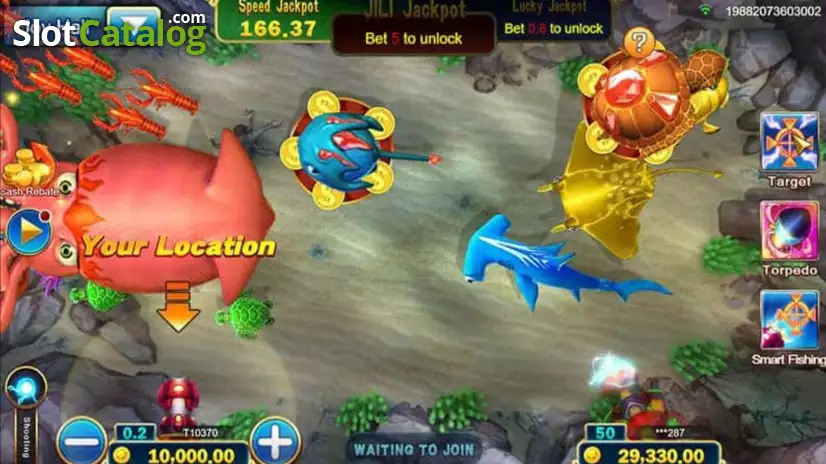
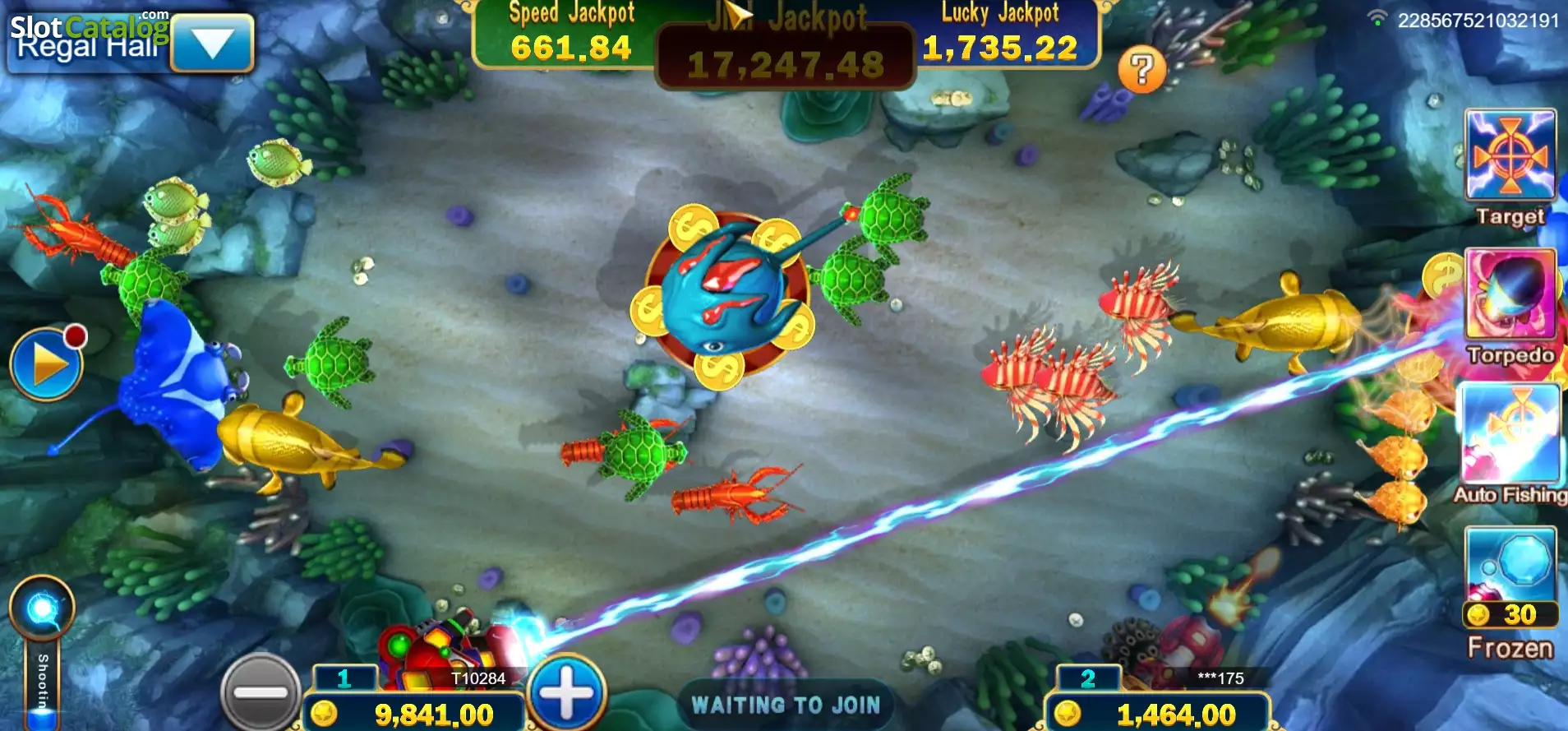
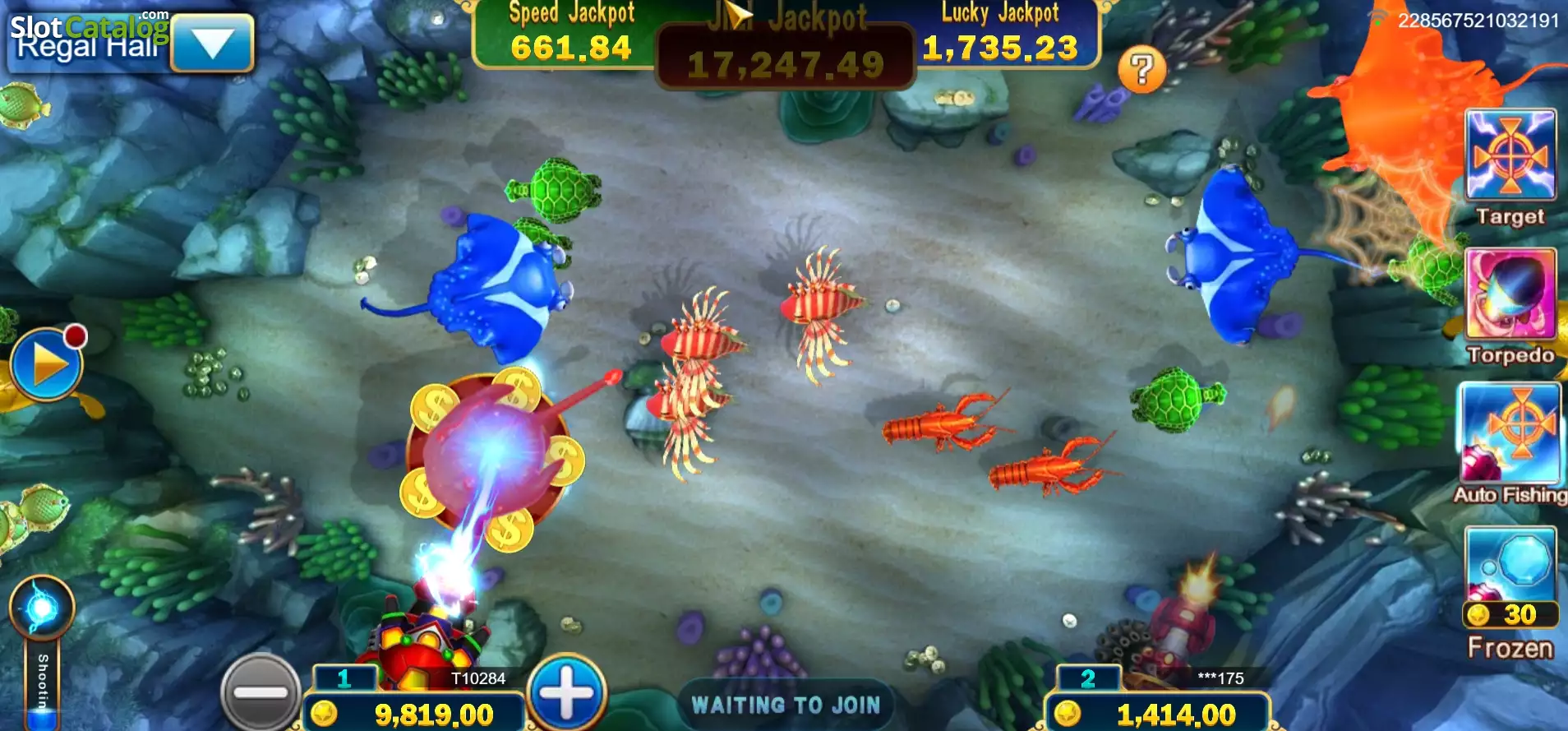
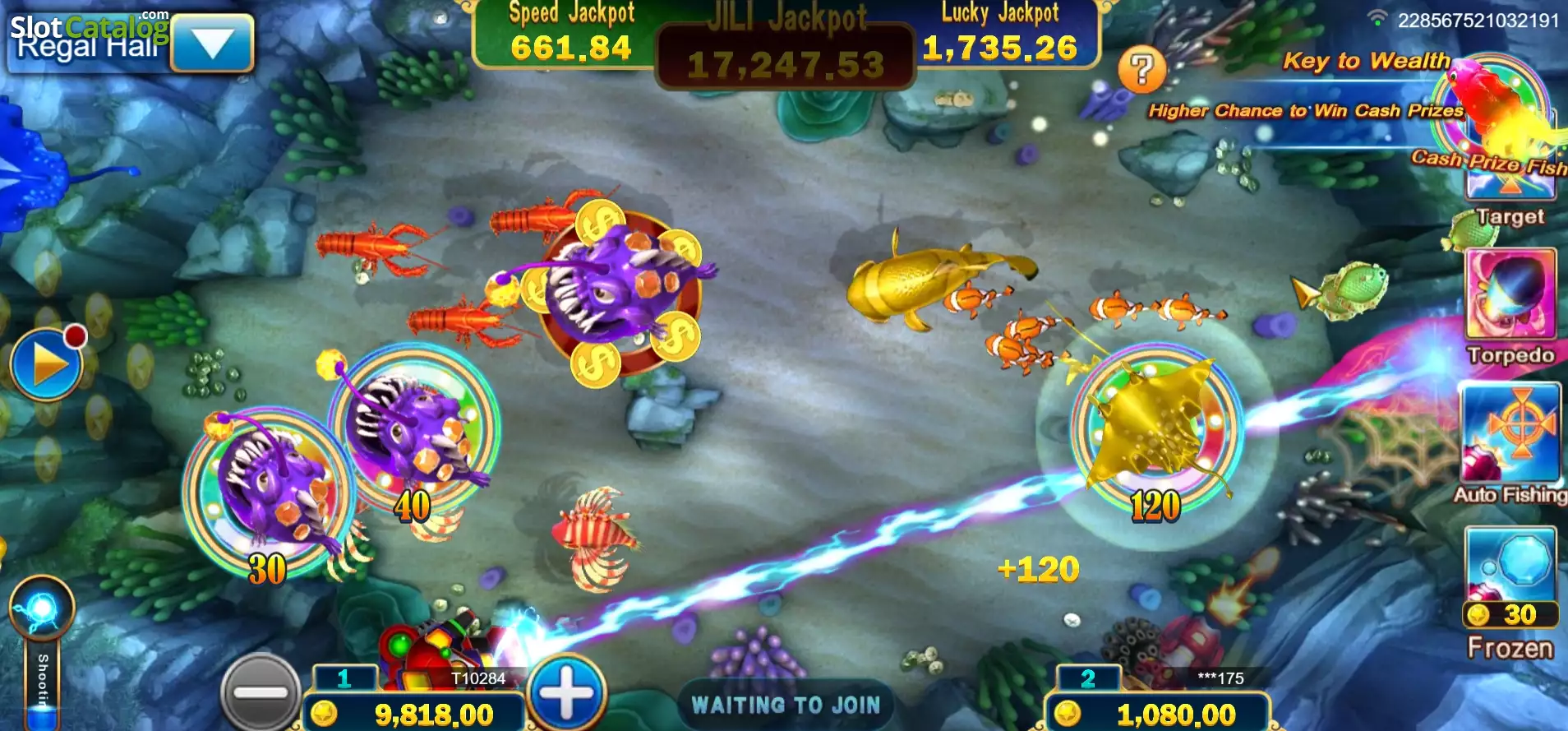
Source note: screenshots were saved from the SlotCatalog gallery for this game and are used here for informational UI reference.
Next step
Ready to practice with structure?
Start with bullets, claim a value lane, use shot caps, and treat weapons as windows. Jackpot Fishing is most enjoyable when you control the pace instead of letting the pace control you.