Mines (Spribe): How to Play, Cash Out Strategy, Tips, Demo
On 6 Club, Mines is a fast, Minesweeper-inspired instant game. You choose how many mines are hidden on a 5×5 grid, place a bet, then open tiles to reveal safe stars. Every safe click increases your multiplier. If you reveal a mine, the round ends and the stake is lost.
The gameplay sounds simple because it is simple. The challenge is discipline. Mines is not a puzzle you solve; it is a risk dial you set. You decide how aggressive the mine count is, and you decide when to cash out. This guide teaches the rules, explains the symbols and controls, and gives you a repeatable session plan that works for both demo and real play.
What to expect
Mines has adjustable risk. The same game can feel calm or extremely sharp depending on mine count and how long you stay in a round. The safest way to learn is to use the demo first, fix your mine count for a block of rounds, and practice cashing out on schedule.
Mines
Set mines • Reveal tiles • Cash out
Play Mines demo
The demo is the best place to learn: you can test mine counts, practice cash-out timing, and get comfortable with the pace. Use demo sessions to create a routine. A stable routine is what keeps Mines fun.
Demo widget
If the embedded demo shows a connection error, use the external demo link below. Some demo providers restrict certain domains.
Playable demo widget
Loads free play from a third-party widget.
Demo drill (simple, effective)
Pick one mine count (for example: a low-risk number). Play 40 rounds and cash out after exactly one safe tile every time. Then play another 40 rounds and cash out after exactly two safe tiles every time. This drill teaches you the pace and helps you feel how quickly risk grows when you stay longer.
On this page
Mines tutorial navigation
Jump to rules, risk levels, strategies, symbols, media, and FAQs.
Overview: Mines is a risk game, not a prediction game
Mines looks like Minesweeper, so many players assume there is a “correct” way to click. In casino Mines, there is no pattern to solve. The mines are hidden and the outcomes are random. The goal is not to outsmart the board; the goal is to set a risk level that fits your budget and then cash out at a planned time.
The most important difference between Mines and reel slots is control. Slots give you control over stake size and sometimes features like bonus buys. Mines gives you control over stake size and how long you stay in a round. You can end a round after a single safe tile, or you can keep going. That choice changes the session shape more than anything else.
A calm Mines session has a steady routine: fixed mine count, stable bet size, and a fixed stopping rule. A chaotic Mines session is fueled by target chasing: changing mine counts after losses and trying to “make a round worth it.” This guide is designed to keep you in the first category.
The mental model that works
Treat each tile reveal as a separate decision point. After every safe tile you have a choice: lock a win now, or risk the entire round for a bigger multiplier. If you can make that choice calmly, Mines becomes straightforward.
How the board works
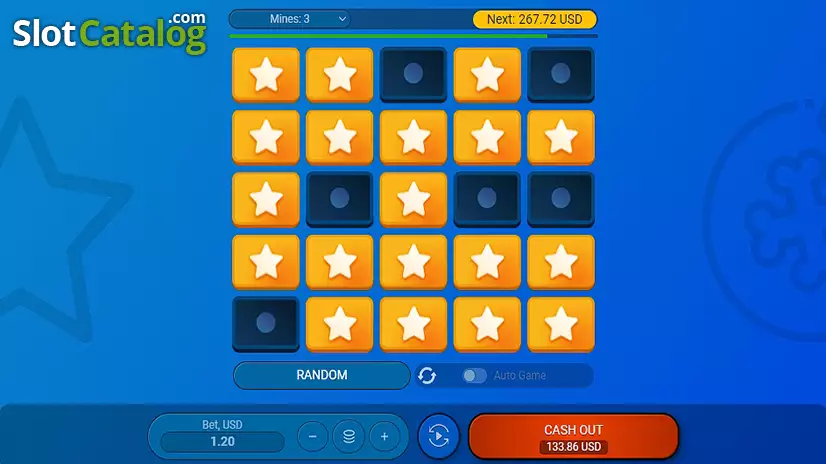
A 5×5 grid has 25 tiles. You choose how many of those tiles are mines. The remaining tiles are safe stars. Your multiplier grows with every safe reveal, and you can cash out after each safe step.
This is an illustrative visual to explain the mechanic; it is not a prediction tool.
How to play Mines (step-by-step)
If you are new, follow the steps with the demo open. The goal is to build a stable routine. Mines rewards calm repetition and punishes impulse.
Step 1 — Decide your session budget
Mines is quick, so it is easy to overplay. Decide an amount you are comfortable spending before the first round. In a well-managed session, your budget is a rule, not a wish.
Step 2 — Pick a mine count
Your mine count is your volatility control. Lower mine counts give more safe tiles and smoother results. Higher mine counts increase multipliers faster but can create longer losing streaks.
Step 3 — Set a bet size you can repeat
Choose a stake that fits your session length. If your plan is 100 rounds, your stake should be small enough that you can complete the plan even if you hit a losing streak.
Step 4 — Start the round and open a tile
Click a tile to reveal what is underneath. If it is a star, your multiplier increases and you can decide to cash out or keep going. If it is a mine, the round ends and the stake is lost.
Step 5 — Cash out according to your plan
Mines is not about “getting lucky once.” It is about repeating a decision. If your plan is “cash out after 2 safe tiles,” do that. You can adjust the plan next session after reviewing results.
Step 6 — End on schedule
Set a round count or a time limit. Stopping is part of the strategy. The most common Mines losses happen when a player keeps raising risk to recover a small deficit.
One line summary
Choose mines, reveal stars, cash out before you click into a mine.
Rules and payouts (what’s actually happening)
A Mines round has a single stake and a single path: you either cash out successfully or you hit a mine and lose the stake. Your multiplier grows as you reveal more safe tiles. Because you can stop at any time, Mines gives you constant control over how much risk you take.
The mine count changes the odds and therefore changes the multiplier growth. With fewer mines, safe tiles are more common, so multipliers grow more slowly. With more mines, safe tiles are rarer, so the multipliers climb faster to compensate. This is why mine count is the most important setting.
It is helpful to think about Mines as a sequence of small risk decisions. Each click is a fresh commitment that stakes everything you have built so far in that round. If you only click once and then cash out, you take a small risk for a small multiplier. If you click many times, you take repeated risks that can compound.
Important fairness note
Mines is commonly listed as using provably fair verification. That means you can verify randomness after the fact using seeds/hashes. Verification does not help prediction; it helps trust.
Mine count and risk: how to choose a setting
Mines lets you choose how many mines are hidden in the 25 tiles. This is the most powerful control in the game. In practice, you should pick a mine count based on two things: the bankroll you are using and how much emotional pressure you want in each round.
Low mine counts are best for learning. They let you practice decision points without constantly losing rounds. Medium mine counts are best for balanced play: you will feel tension, but you can still execute a routine. High mine counts are for short, high-intensity sessions where you accept that losing streaks are normal.
Low mine count
Best for: training and calmer sessions. You will cash out more often if you keep your click count small, which helps you stick to a plan.
High mine count
Best for: short sessions and players who enjoy sharper variance. Multipliers rise quickly, but a single mistake ends the round immediately.
A stable approach
Choose one mine count and keep it for at least 50 rounds. Changing mine count every few rounds usually means you are reacting to results. Reacting is what makes Mines expensive.
Cash out strategy: the real skill in Mines
Mines is often misunderstood as a “how far can you go” game. That framing creates greed and turns sessions into a chase. A healthier framing is this: every round is a small decision tree, and the best players end rounds early and often.
The cash out button is your win condition. If you reach a multiplier you planned for, the correct move is to cash out even if it feels like the board could continue. The moment you start playing “one more tile,” you are trading discipline for hope.
If you are building a serious routine, you should decide your cash-out rule in terms of a click limit, not in terms of chasing a particular win amount. Click limits are stable. They do not change because the last round was a win or a loss. That stability protects you from the most common Mines failure mode: increasing risk because you feel “close” to a bigger payout.
A useful way to structure Mines is to treat your round as having two roles. The first role is “banking,” where you lock small multipliers repeatedly to keep the session steady. The second role is “attempts,” where you intentionally take a slightly longer path. Attempts should be limited in number and planned in advance. When attempts are planned, they remain entertainment. When attempts happen because you are frustrated, they become chasing.
A simple rule
If your heart rate increases, cash out. Mines is designed to make you feel urgency. Ending rounds calmly is the whole point of a plan.
Bankroll and session plan (Mines-specific)
Mines can feel more controllable than slots because you decide when to stop a round. That feeling is partly true, but it can also be dangerous: the game is fast, and fast games can consume a bankroll quickly when you increase risk after losses. A session plan keeps you in control.
A practical Mines plan is built on three numbers: your total session budget, your target number of rounds, and your per-round stake. Choose the budget first. Then choose the round count. Finally, set a stake that makes the round count possible even if variance goes against you.
Stop-loss (protects you)
Set a loss limit that ends the session automatically. The exact number depends on your budget, but the idea is consistent: once you hit the limit, stop. Mines is most expensive right after a stop-loss moment because that is when players are tempted to raise mine counts.
Stop-win (protects your wins)
Also set a win target where you walk away. A good Mines habit is leaving while the session still feels clean. If you keep playing after a satisfying win, you are likely to give it back to variance.
Block method (highly recommended)
Divide your session into blocks of rounds (for example: 25 rounds per block). For each block, keep the same mine count and the same cash-out rule. At the end of the block, take a short break and decide whether to continue. This turns Mines into a controlled routine instead of a continuous chase.
Probability intuition (why risk rises fast)
You do not need to calculate exact odds to play Mines well, but it helps to understand why the game feels smooth for a moment and then suddenly feels sharp. The board has 25 tiles. If you choose $m$ mines, there are $25-m$ safe tiles. Each time you click, you are effectively drawing one tile without replacement.
The first click is a single risk event. The second click is another risk event on a slightly smaller board. Your chance of surviving multiple clicks is the product of surviving each click. That is why longer rounds become dramatically riskier even if the board “looks safe.”
This is also why click limits are so powerful. When you cap your round at one or two safe tiles, you keep risk within a predictable band. When you start adding “just one more tile,” you are multiplying risk decisions. The multipliers increase to match that risk, but the emotional pressure increases too.
Practical takeaway
If you want a calmer session, lower your mine count and lower your click limit. If you want a more intense session, raise one dial at a time. Raising both together is how players burn budgets quickly.
Strategies you can execute consistently
There is no guaranteed winning strategy in Mines or any casino game. The closest thing to a “strategy” is risk management: stake sizing, consistent mine counts, and consistent cash-out rules. These plans are designed to be simple enough that you can actually follow them.
Plan 1 — One click then cash out
Pick a low mine count and cash out after one safe tile. This is the calmest plan. It teaches discipline and reduces the urge to chase big rounds.
Best for: beginners and bankroll stretching.
Plan 2 — Two-click routine
Use a modest mine count and cash out after two safe tiles. This adds excitement while still keeping decisions simple. Play in blocks: 25 rounds, review, then stop or continue.
Best for: balanced sessions and steady practice.
Plan 3 — Random button for consistency
If you hesitate or overthink tile choice, use Random and keep your cash-out rule fixed. Random does not change odds, but it prevents the common error of “I should have clicked another tile,” which often leads to chasing.
Best for: players who tilt after near misses.
Plan 4 — Short high-risk blocks
Choose a higher mine count but limit your session to a short block (for example: 20 rounds). This keeps the intensity controlled. If you cannot keep the block limit, this plan is not suitable.
Best for: experienced players who can stop on schedule.
Avoid doubling systems
Increasing stake after losses can feel logical, but it accelerates risk. Mines can produce sharp streaks, especially with higher mine counts. If your plan relies on doubling, it is likely to break under variance.
Tips and tricks (practical, not hype)
These tips are designed to keep your sessions stable. Mines becomes expensive when you change settings based on emotion. It becomes manageable when you keep settings stable and treat outcomes as normal variance.
Tip 1 — Fix your mine count for a full block
Commit to a mine count for at least 50 rounds. This prevents “risk shopping” after a few losses.
Tip 2 — Use a click limit
Decide how many safe tiles you will open before cashing out. A click limit is more reliable than playing by feelings.
Tip 3 — Keep stakes flat
Flat staking makes your results easier to interpret and reduces emotional swings. Adjust stakes between sessions, not inside a streak.
Tip 4 — Treat Random as an execution tool
If you overthink tile selection, use Random. It does not improve odds, but it improves discipline.
The best trick is stopping
Mines sessions are easiest to win when you end them. A planned stop-loss and a planned stop-win protect you from giving back earlier gains.
Common mistakes (and the fixes)
Mistake 1 — Raising mine count after a loss
This is the Mines version of chasing. If the session is down, raising mine count adds risk and usually makes it worse. Fix: keep mine count stable for the session.
Mistake 2 — Playing without a cash-out rule
Without a rule, you will cash out late when you are greedy and early when you are scared. Fix: use a click limit (one, two, or three safe tiles).
Mistake 3 — Stake escalation
Increasing stake after a bad run speeds up loss. Fix: choose a flat stake and play a fixed number of rounds.
Mistake 4 — Treating mines like a puzzle
If you start looking for patterns, you will justify bigger risks. Fix: accept randomness, focus on controllables.
The short version
Mines punishes emotional adjustments. It rewards boring consistency.
Symbols and UI elements (what everything means)
Mines does not have reel symbols like wilds or scatters. Instead, it has a small set of UI elements that function like “symbols”: they tell you what state the round is in and what choices you have.
Core symbols
Names vary by casino theme; meaning stays the same.
Covered tile
Meaning: A hidden tile you have not opened yet.
Impact: Each opened tile is a new risk decision. Your round only ends safely if you cash out before opening a mine.
Star / gem
Meaning: A safe tile (a win step).
Impact: Every safe tile increases your multiplier. The value of the next click depends on how many mines you selected.
Mine / bomb
Meaning: A losing tile.
Impact: Hitting a mine ends the round and loses the stake for that round, including any uncashed gains.
Mines selector
Meaning: A control for how many mines are placed on the board.
Impact: The main difficulty dial. Fewer mines is calmer; more mines increases multipliers but also increases losing streak risk.
Random button
Meaning: Lets the game pick a tile for you.
Impact: Removes hesitation and keeps decisions consistent, but it does not improve odds. It is execution, not advantage.
Cash Out
Meaning: Locks your current multiplier and ends the round safely.
Impact: This is your primary skill. The best Mines sessions are built around a cash-out plan, not around hoping for perfection.
Multiplier
Meaning: The growing payout factor for your current round.
Impact: The multiplier is the reward for risk. Higher mine counts accelerate it; your job is to decide where to stop.
Informational visual
The board is a 5×5 grid. Safe tiles push the multiplier higher. Mines end the round instantly. The only sustainable approach is to define your click limit and cash out without negotiation.
Provably fair verification (simple explanation)
“Provably fair” is a verification method that lets players validate that rounds were generated using published cryptographic data (seeds/hashes). In practice, you may see a fairness panel with a server seed, client seed, and nonce. After a round, you can verify that the board arrangement was produced fairly.
This matters for trust, not for prediction. Verification does not reveal where mines are before you click. It simply lets you confirm that the outcome was not changed after the bet.
Practical takeaway
Use provably fair tools for confidence, then focus on what you control: stake size, mine count, click limit, and session length.
Playing Mines on mobile (best practices)
Mines is popular on mobile because the interaction is simple and the rounds are quick. The downside is that mobile play can increase speed and reduce the “pause” that helps you make calm decisions. These habits keep mobile sessions controlled.
Disable speed play when learning
If your UI has fast animations or quick repeat options, keep them conservative while training. You want enough time between rounds to remember your rule and execute it.
Tap accuracy matters
Mines is one-tap risky. Make sure you are not playing while distracted. Accidental extra taps are the fastest way to break a click limit.
Use block timing
Mobile is ideal for short blocks. Pick a 10-minute window, play a fixed number of rounds, then stop. Short blocks reduce chasing.
Keep stake and mines visible
Before every round, glance at two things: mine count and bet size. That small check prevents “drift” where settings change without you noticing.
Mobile rule of thumb
If you are playing faster than you can remember your rule, slow down or stop. Mines should feel deliberate, not automatic.
Mines images and videos (reference)
The screenshots below are saved locally for reliability. Your casino build may look slightly different, but the core controls and grid mechanic are the same.
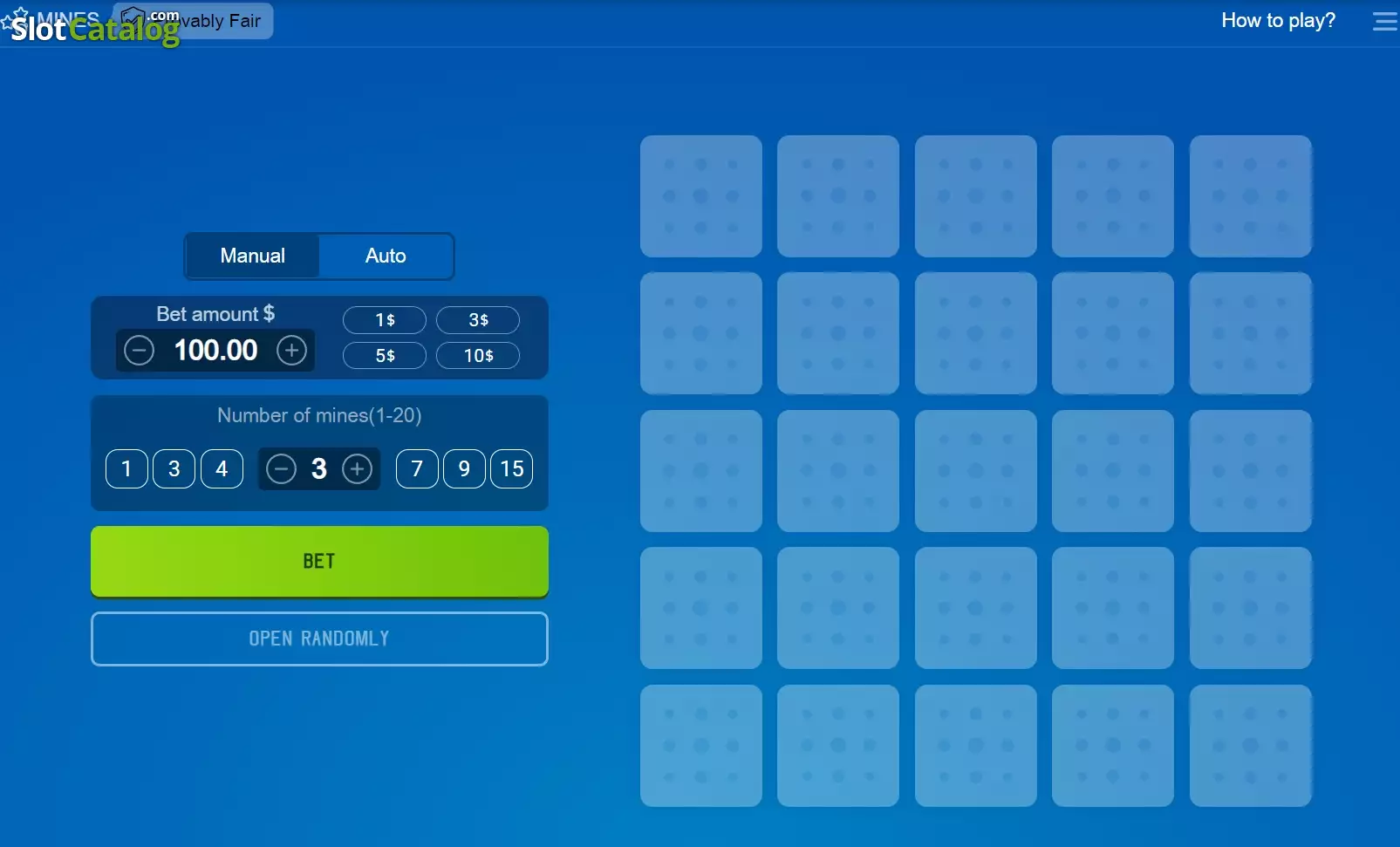
Game screen
Opens full-size in a new tab.

Lose screen
Opens full-size in a new tab.
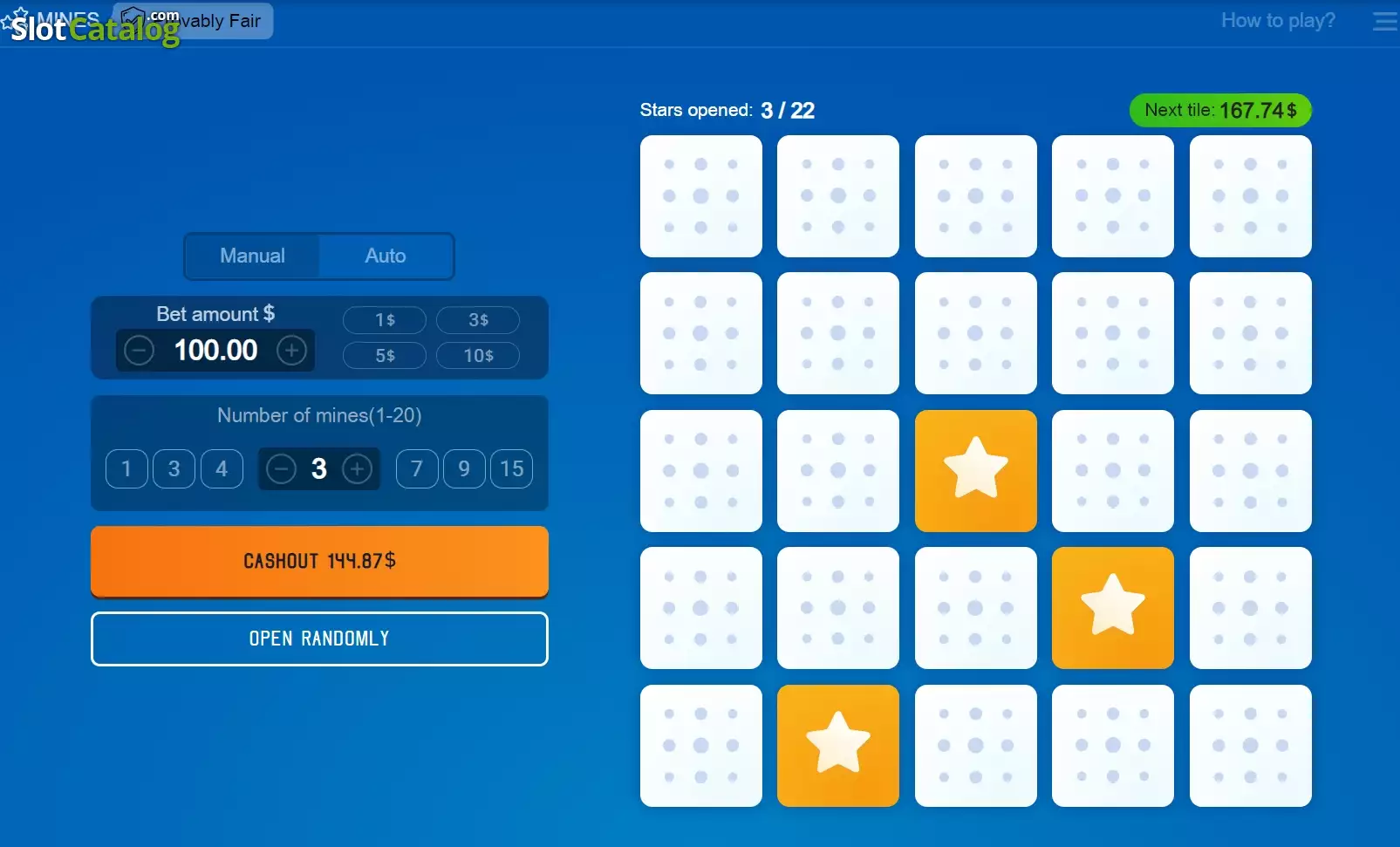
Win screen
Opens full-size in a new tab.
Gameplay videos
Embedded as a YouTube search playlist so you can pick a walkthrough that matches your UI.
Use videos to understand the rhythm: bet, choose mine count, click, cash out. Do not use videos as “pattern guides.” Mines outcomes are random.
Frequently asked questions
What is Mines (Spribe)?+
Is Mines a slot game?+
What is the RTP of Mines?+
How many mines should I choose?+
Can I cash out anytime?+
Does Mines have a free demo?+
Is Mines provably fair?+
Does clicking a corner tile help in Mines?+
Should I use the Random button?+
What is a good beginner plan for Mines?+
Glossary
Mine count
The number of losing tiles hidden on the 25-tile grid.
Safe tile
A star/gem tile that increases your multiplier and allows you to continue or cash out.
Cash out
Ending the round intentionally to lock the multiplier you have reached.
Tilt
Emotional play that leads to raising risk, stakes, or changing rules mid-session.
Final reminder
Mines is simple enough that it can feel harmless. The speed is the real risk. Use fixed mine counts, fixed click limits, and fixed session lengths.