Go Rush Crash Game: How to Play, Cash Out Strategy, Tips, and Demo
Go Rush is a crash-style game: instead of spinning reels and matching symbols, you watch a multiplier climb until the round crashes. Your entire decision is timing. Cash out early to lock smaller, steadier returns, or hold longer for bigger multipliers that can also disappear in an instant. This guide is written as a practical tutorial for real play on 6 Club and for safe practice in the free demo.
You will learn the core controls, how dual bets work, how Auto Cash Out and partial cash out change your risk, and how to build a simple, repeatable plan. Crash games move fast, so the goal is clarity: your bet size, your target, and your stop conditions should be decided before emotion arrives. Play Go Rush on 6 Club after registration and 6 Club Login. Visit all slots or try Fortune Gems.
Fairness note
Crash games can feel personal because timing is involved, but each round is random. Go Rush is commonly listed as offering provably fair verification, which is a transparency layer that lets you validate outcomes. Whether you play demo or real, always keep your session plan separate from recent streaks.
Go Rush
Cash out before the crash

Play Go Rush demo
Use the demo to learn the interface and build muscle memory for cash outs. The best demo goal is not “win big.” The best goal is “execute a plan without changing it mid-round.” Once you can do that, real play becomes calmer.
Demo widget
If the embedded demo shows a connection error, use the external demo link below. Some free demo providers restrict certain domains.
Playable demo widget
Loads free play from a third-party widget.
Demo drill (5 minutes)
Set a small test bet. Choose an Auto Cash Out target (for example, an early “stability” number). Play 30 rounds without touching the target. Your goal is to experience both outcomes: frequent small cash outs and sudden crashes. If you can keep your target stable during the demo, you are ready to move to a real session plan.
On this page
Go Rush tutorial navigation
Jump to setup, dual bets, cash out mechanics, strategies, images, and FAQs.
Overview: what Go Rush really is (and what it is not)
Go Rush sits in the “crash” family of games. That matters because it changes the mental model. In a reel slot, you are betting on a combination appearing. In a crash game, you are betting on surviving long enough to lock a multiplier. The game gives you a fast-moving line that rises, and your job is to decide where you want to step off.
The simplest way to describe Go Rush is this: every round has two possible outcomes for your bet. Either you cash out in time and you win your multiplier, or the crash happens first and you lose that bet. There are no paylines to optimize, no symbol tables to memorize, and no “bonus round” to chase. The excitement comes from the tension between an early lock and a higher target.
That simplicity is also why crash games require discipline. Because the interface is minimal, it is easy to click quickly, raise stakes too fast, or change targets based on the last few rounds. A strong session is not about guessing the next crash point. It is about making the same high-quality decision hundreds of times.
A useful mindset
Treat your cash-out target as your “feature choice.” In a slot you might choose a high-volatility game to chase bonus rounds. In Go Rush you choose a higher target to chase bigger multipliers. Your target is the volatility switch.
Risk vs. target
Your expected session shape is mostly determined by your cash-out goals. Lower targets tend to cash more often but pay less. Higher targets can create bigger wins but also longer losing streaks.
This graphic is an intuition tool, not a prediction model. Actual crash outcomes are random.
How to play Go Rush (step-by-step tutorial)
This section is written as a hands-on walkthrough. If you are new to crash games, follow it in order while the demo is open in another tab. If you are experienced, skim the steps and jump to the strategy section to refine your plan.
Step 1 — Decide your session budget and round count
Crash games run quickly. Before you click anything, decide how many rounds you want to play (for example: 80 or 120) and what you are willing to spend if the session goes poorly. The purpose is control. When you have a round count, it becomes harder to “keep going just one more.”
Step 2 — Choose one target multiplier
Pick a number you will cash out at. New players do best with targets that feel modest because they help you learn pace. Your goal is not perfection; your goal is consistency. You can revise targets between sessions, not between rounds.
Step 3 — Place your bet (or bets)
Go Rush commonly supports two separate bet panels. You can use only one panel for a simple session, or use both when you want a structured split: one earlier cash out and one higher target. If you do not have a plan for the second bet, leave it off.
Step 4 — Watch the round and cash out
When the rocket launches, the multiplier begins climbing. You can cash out manually at any time, or let Auto Cash Out do it for you. If you cash out before the crash, your profit is credited. If the crash happens first, the bet is lost. That is the whole game.
Step 5 — Log outcomes, not streaks
It is tempting to focus on “hot” and “cold” streaks. Instead, track what matters: how many rounds you played, what your average target was, and whether you followed your plan. Streak thinking encourages chasing and target-switching.
Step 6 — End the session on schedule
If you reach your round count, stop. If you hit a pre-defined stop-loss or stop-win, stop. Crash games reward repetition and punish impulse. Ending on time is a skill. The most profitable long-term habit is leaving a good session intact instead of giving it back to the next streak.
Important clarification
There is no reliable way to predict when a crash will occur. If you find yourself trying to “read” the last few results, switch your focus back to stake sizing and targets. Those are the parts you control.
Controls: what each setting changes
Go Rush looks simple, but the control panel is doing real work. Most player mistakes are not about choosing the wrong multiplier once. They are about changing settings too frequently, turning on automation without limits, or over-sizing bets when the pace speeds up.
Bet amount
Your stake is the foundation. In a crash game, the easiest way to lose control is to raise stakes after a few crashes. Pick a bet you can repeat for your full round plan. If you want to increase intensity, do it next session, not mid-session.
Manual vs Auto Cash Out
Manual cash out rewards attention and reaction. Auto Cash Out rewards planning. Many players prefer Auto Cash Out because it eliminates “hesitation” and prevents the common mistake of waiting an extra half-second.
Partial cash out (where available)
Partial cash out is a risk tool, not a magic trick. It allows you to take a portion of your profit or recover some stake and keep a smaller portion running. Think of it as buying yourself calm: you are less emotionally invested in the rest of the round.
Autoplay limits
Autoplay can be helpful for executing a plan precisely, but only if you define boundaries: number of rounds, a loss limit, and a clear stop. Without limits, autoplay simply increases speed, and speed increases risk.
A simple rule for every toggle
If you cannot explain why a setting is on, turn it off. Crash games are already high-tempo. Keep the interface quiet until you are ready for a more advanced two-bet plan.
Two bets in one round: the cleanest way to structure risk
Dual bets are the feature that turns Go Rush from “pure impulse” into “structured play.” It is tempting to use two bets as a way to chase more action. The better use is balance: one bet is your stability anchor; the second bet is your upside attempt.
Pattern A — Anchor + attempt
Bet 1 uses a lower Auto Cash Out target. Bet 2 uses a higher target. If the round ends early, you might lose both. If the round survives beyond the first target, the anchor bet locks something and the second bet can continue.
Pattern B — Same target, different stake
Both bets cash out at the same target, but one bet is smaller. This is a simple way to test sizing: you can keep your plan while exploring whether you prefer more or less exposure per round.
A warning about two-bet play
Two bets double your exposure. If you enable the second panel, reduce the per-bet stake so your total risk per round stays within your session plan. The easiest mistake is keeping the same stake on both panels, which silently doubles your spend rate.
Cash out mechanics: timing, targets, and discipline
Cash out is the heart of Go Rush. Many players assume crash games are about reflexes. In reality, most successful play looks boring: pre-set targets, stable bets, and a willingness to accept that some rounds will crash early.
Manual cash out
Manual cash out is useful when you want to read the round and adapt. The downside is hesitation: players often wait “just a little longer,” then lose the entire bet. If you go manual, decide your target anyway and treat the button as execution, not debate.
Auto Cash Out
Auto Cash Out is the most important safety feature for most players. It transforms the game from reaction to routine. Your job becomes choosing a reasonable number and sticking to it. If you change the number every few rounds, you lose the benefit.
The “one more tick” trap
Crash games create a very specific temptation: you see the multiplier rising smoothly and you want to squeeze a little extra value. That feeling is exactly why many players give back earlier wins. Solve it with structure: auto targets, a fixed round count, and stake sizes that do not force you to recover anything.
Auto tools: autoplay, auto cash out, and safety limits
Automation is powerful, but it must be fenced. The purpose of autoplay is to execute a plan without the emotional swings of manual clicking. The risk is that automation increases speed, and speed increases how quickly you can run through your bankroll.
Good use case
You have a small stake, an Auto Cash Out target, and a fixed number of rounds. Autoplay helps you execute without second-guessing. This is ideal for demo training and for disciplined real sessions.
Bad use case
You are upset about a loss and you enable autoplay to “get it back quickly.” That is chasing, and crash games punish chasing. If autoplay is on, your plan must already be calm.
Recommended safety checklist
- Set a round count (for example, 50 or 100 rounds), not “infinite.”
- Use a small, repeatable stake that fits the full round plan.
- Choose targets before you start and keep them stable for the session.
- Stop the moment you feel rushed, irritated, or tempted to increase targets.
Provably fair: what it means and how to use it
“Provably fair” is a verification concept: the game can provide cryptographic data (seeds/hashes) that allow you to validate that the outcome for a round was generated fairly. The important point is what it does and does not do.
What it does
It gives you transparency. You can inspect the seeds used to generate a round and verify the round was not “changed” after you placed a bet. Verification is especially relevant for crash games because players often wonder whether the crash point is being manipulated.
What it does not do
It does not allow prediction. You cannot look at the fairness data and forecast the next crash. Every round remains random. The value is auditability and confidence, not a strategy edge.
Practical takeaway
Use provably fair tools as reassurance, not as a reason to take bigger risks. Your best protection is still bankroll discipline and a fixed plan.
Strategies (simple plans you can actually follow)
There is no guaranteed winning strategy for any RNG-based casino game. What you can do is choose a risk profile and execute it consistently. Below are practical approaches that focus on discipline rather than “systems.” Use the demo first, then bring one plan into real play.
Plan 1 — Conservative single-bet routine
Use one bet panel with a modest Auto Cash Out target. Keep the same stake for a fixed number of rounds. This plan is boring by design. It helps you learn how often early crashes happen and whether your nerves stay calm.
Best for: players who want smoother sessions and minimal decision fatigue.
Plan 2 — Two-bet split (anchor + upside)
Use two bets with different targets. The anchor bet aims to lock something frequently. The upside bet aims higher. Keep total exposure per round similar to what you would normally risk with one bet, otherwise the plan becomes too expensive.
Best for: players who want variety without constant target switching.
Plan 3 — Partial cash out as insurance
If your version supports partial cash out, you can treat it like a seatbelt. When a round reaches your first comfort zone, cash out half. Then let the remaining half aim for a higher point. This reduces the emotional pressure of “all-or-nothing” outcomes.
Best for: players who tilt after losing a near-miss.
Plan 4 — Time-boxed practice blocks
Instead of chasing a number, chase clean execution. Choose a 10-minute practice block with small stakes and a fixed target. When the timer ends, stop. This approach is excellent for players who tend to lose track of time.
Best for: mobile sessions and responsible play habits.
Why we avoid “martingale” advice
Some crash players try increasing stakes after losses to recover quickly. In practice, this escalates risk and can blow a bankroll in a short streak of early crashes. If your plan requires doubling, it is not a plan—it is a countdown.
Tips and tricks (high value, low noise)
Tips are only useful if they are actionable. These are written to reduce common crash-game mistakes: target switching, over-sizing bets, and turning a fun session into a chase.
Tip 1 — Use Auto Cash Out even if you play manually
Think of Auto Cash Out as your guardrail. You can still cash out earlier manually, but the auto target prevents the “freeze” moment where you wait too long and lose everything.
Tip 2 — Keep targets stable for at least 30 rounds
If you are changing your target every few rounds, you are not playing a strategy—you are reacting. Stability gives you meaningful feedback. You can review results after a block and decide whether the plan suits you.
Tip 3 — Split bets only when the math is controlled
Dual bets are great, but only if you scale the amounts down so total exposure stays reasonable. Two bets should feel like “a structure,” not “double speed.”
Tip 4 — Stop after a tilt signal
A tilt signal is any moment you feel urgent: raising stakes, raising targets, or wanting to “win it back quickly.” The correct action is to stop, even if the last round was small. Stopping is what saves sessions.
A good Go Rush session feels predictable
Predictable does not mean “you always win.” It means you know exactly what you are doing, you know how much you can lose, and you know when you will stop. When those things are true, the game stays entertainment.
Common mistakes (and how to avoid them)
Mistake 1 — Target chasing
After a few low crashes, players often raise targets to “make the session worth it.” That increases risk precisely when emotions are high. Replacement habit: keep targets fixed for the session, then review calmly afterward.
Mistake 2 — Doubling after losses
Doubling feels logical because it promises a quick recovery. In crash games, a short chain of early crashes can wipe out a bankroll. Replacement habit: decide stake size from your round plan, not from the last result.
Mistake 3 — Autoplay without limits
Autoplay can turn a 20-minute session into a 3-minute burn. Replacement habit: always set a round count and a stop-loss, even in demo mode.
Mistake 4 — Reading history like a forecast
Recent multipliers are interesting but not predictive. Replacement habit: use history as a record, not as a signal. Your only reliable edge is risk control.
If you only remember one thing
Crash games feel simple, so players underestimate them. Go Rush is easiest when you treat it like a routine: fixed targets, fixed rounds, fixed stake, then stop. Everything else is noise.
Interface elements (Go Rush “symbols” explained)
Go Rush does not use classic slot symbols. Instead, it has interface elements that matter: the multiplier curve, cash out controls, and verification tools. Think of these as the “symbol set” you must learn.
Core UI elements
Descriptions are written as a player tutorial. Your casino UI can vary slightly.
Multiplier curve (rocket flight)
What it does: The round starts and the multiplier climbs upward until it crashes.
Why it matters: Your payout is your bet multiplied by the cash-out multiplier. Waiting longer increases potential profit and also increases the chance of losing the round.
Bet panels (left / right)
What it does: Two independent bets can run in the same round.
Why it matters: You can split your risk: cash one bet out early for stability and let the second bet aim higher for a bigger return.
Cash Out button
What it does: Ends your bet at the current multiplier and locks the result.
Why it matters: Cashing out is the entire skill of crash games: you are choosing a risk level each round.
Auto Cash Out
What it does: Automatically cashes out at a chosen multiplier target.
Why it matters: Removes reaction-time pressure and keeps decisions consistent. The tradeoff is you must pick a sensible target before the round.
Autoplay
What it does: Runs rounds automatically using your current bet settings.
Why it matters: Convenient for practicing a plan, but it can also increase spend-rate if you do not cap rounds or set loss limits.
Partial cash out (50%)
What it does: Lets you cash out part of your position while leaving the rest active.
Why it matters: A practical compromise: you take some profit or recover some stake, while still giving the round a chance to run higher.
History bar
What it does: Shows recent multipliers for previous rounds.
Why it matters: It is useful for pace and record-keeping, but it should not be used as a prediction tool. Each round is independent.
Provably Fair / Shield
What it does: Lets you verify the randomness of rounds using seeds and hashes.
Why it matters: It is an extra transparency layer: you can verify outcomes were generated fairly rather than ‘decided’ after you place a bet.
Once you can identify these elements instantly, your play becomes calmer. You stop fighting the interface and start executing a plan.
Go Rush images and videos (reference)
The images below are provided as references for the typical Go Rush layout. Exact colors, menus, and labels can vary by casino build, device, and version. Click any image to open it in a new tab.
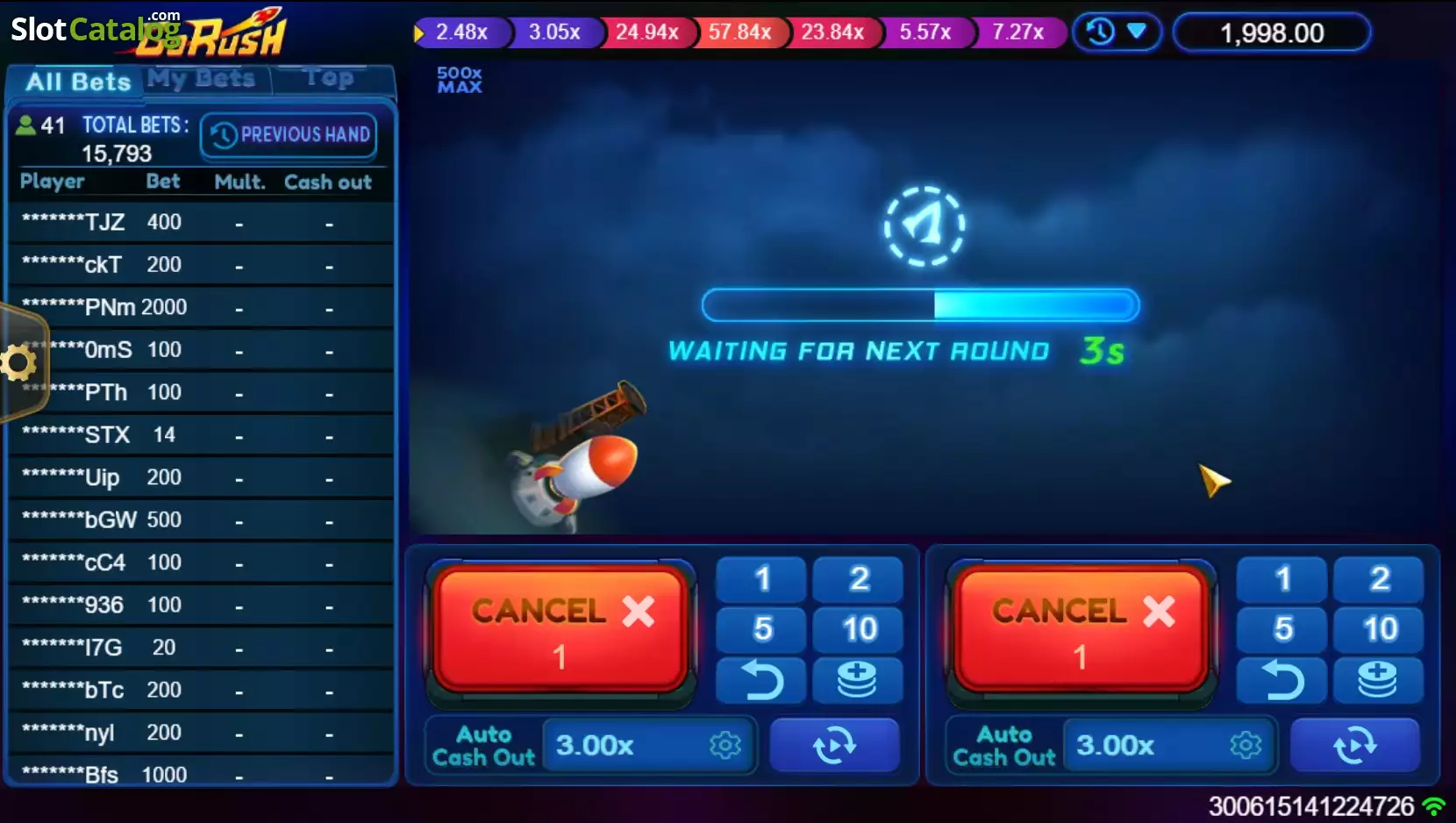
Gameplay screen
Opens full-size in a new tab.

Reel / flight view
Opens full-size in a new tab.
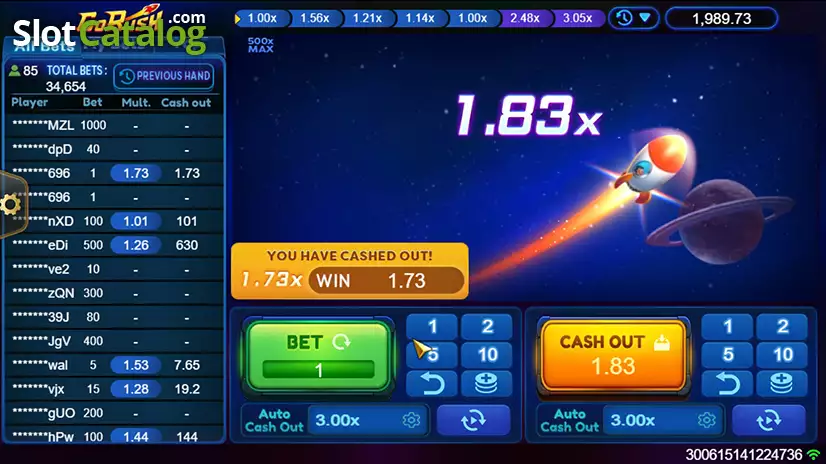
Gameplay screen (alt)
Opens full-size in a new tab.
Gameplay videos
Embedded as a YouTube search playlist so you can choose a walkthrough that matches your device/UI.
If a video shows a slightly different interface, focus on the universal pieces: two bet panels, the rising multiplier, and cash-out controls. Those are the core mechanics across Go Rush builds.
Frequently asked questions
What is Go Rush?+
Is Go Rush a slot?+
What is the RTP of Go Rush?+
Can I play Go Rush with two bets?+
Does Go Rush have symbols, wilds, or scatters?+
What is Auto Cash Out?+
Is Go Rush provably fair?+
Where can I practice Go Rush for free?+
Glossary (quick definitions)
Crash
The moment a round ends. Any bet not cashed out before the crash loses.
Multiplier
The number that rises during the round. Your payout is based on the multiplier you lock.
Cash out
Ending your bet at the current multiplier to secure winnings.
Auto Cash Out
A setting that automatically cashes out your bet at a chosen multiplier.
Final reminder
Crash games are fast and emotional by design. The only parts you control are stake size, targets, and session length. If you keep those stable, Go Rush stays fun and manageable.