Fishing • Onestick Fishing
Onestick Fishing: a complete how-to guide for CQ9Gaming’s multiplier fishing shooter
Onestick Fishing is a fast-paced fishing shooter with a Monkey King legend theme. It plays like an arcade game, but it behaves like a casino game: every bullet is a wager, and discipline matters more than reflexes. This guide teaches a practical approach: understand the controls, use bullet caps, prioritize targets by screen time, and treat multipliers and bosses as short, planned windows.
Depth note: this page is intentionally written at 3000+ words to rank for searches like “Onestick Fishing how to play”, “Onestick Fishing tips and tricks”, “Onestick Fishing RTP”, “Onestick Fishing multiplier”, “Onestick Fishing boss”, and “Onestick Fishing demo”.
What makes it special
Multiplier windows + boss timing
Discipline creates consistency.
Foundation
Base cannon
One level most shots.
Control
Bullet caps
Rotate targets.
Timing
Windows
Short premium attempts.
Exit
Timer
Stop on schedule.

Overview: what Onestick Fishing is and how to play it well
Onestick Fishing sits in the “fishing shooter” family of casino arcade games. Targets move across the screen, you pay per bullet, and you collect prizes when a target is captured. Compared to reel slots, the pace is entirely under your control, which is both the fun part and the danger. If you shoot constantly at a high cannon, results can swing fast.
The goal of this guide is to make the game feel structured. Structure does not mean playing slowly forever. It means choosing when to spend and when to wait. It means treating premium targets, multipliers, and bosses like short projects with a clear start and end, rather than like a never-ending chase.
You’ll see a repeated theme throughout this page: the best edge in fishing games is not secret knowledge. It’s the ability to follow a simple rule under pressure. Bullet caps, base cannon discipline, and planned boss windows sound boring until you realize they prevent most bad sessions.
The Monkey King legend theme is also a helpful mental model. In myth, the Monkey King wins by strategy, not by flailing. Treat Onestick Fishing the same way: observe the battlefield, choose the right moment, strike with focus, and leave when the moment ends.
Quick facts
Provider
CQ9Gaming
SlotCatalog lists Onestick Fishing as a CQ9Gaming title.
Release
2025-06-05
Release date is listed in the game attributes on SlotCatalog.
Type
Fishing shooter (arcade)
This is not a reel slot. You aim and shoot; each bullet is a wager.
RTP
96%
SlotCatalog lists RTP 96%. Short sessions can swing widely because shooting games spend quickly.
Max win
Up to x1000
SlotCatalog lists max win x1000. Big outcomes usually come from planned high-value windows, not random spraying.
Bet range
0.1–10
SlotCatalog lists min bet 0.1 and max bet 10 (currency equivalent). Casinos can map these to local currencies.
Features
Multiplier, Shooting game
Multipliers reward timing. Good players plan a window, then exit.
Technology
JS, HTML5
Built for modern browsers and mobile-friendly play.
Game size
64 MB
SlotCatalog lists the size as 64 MB. If loading feels slow on mobile, prefer Wi‑Fi and close background apps.
Data source note: quick facts like RTP, release date, max win, and bet range are from SlotCatalog’s Onestick Fishing attributes table. If your in-casino version feels slightly different, that’s normal: operators can customize UI, currency mapping, and some limits.
How to start Onestick Fishing on 6 Club
Your first goal is control. If you learn control first, you can later add speed, bigger targets, and premium windows without losing the plot. If you learn chaos first, you will spend most of your time trying to unlearn habits.
Open Onestick Fishing from Fishing
In 6 Club, go to Our Games → Fishing and choose Onestick Fishing. The Fishing gallery uses your local thumbnail (onestick fishing.webp) and routes to this guide at /our-games/fishing/onestick-fishing.
Decide your ‘base bullet cost’ before the first shot
In fishing shooters, your finger sets the spend-rate. Pick one conservative cannon level (or bet-per-shot level) that you can sustain for at least 20 minutes. This becomes your default level for normal targets.
Use one guardrail that prevents almost every tilt
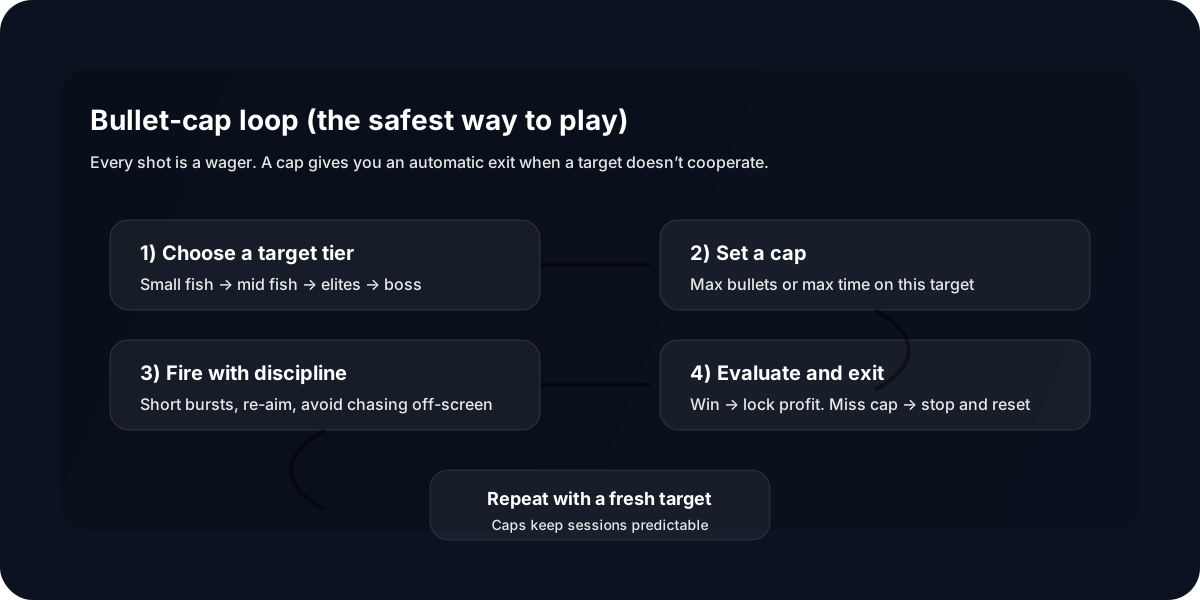
Set a bullet cap per target. Your cap can be a fixed number of bullets, or a time cap (for example, 10–20 seconds of focused fire). If the target doesn’t drop inside the cap, you stop and rotate. This turns a chaotic game into a predictable loop.
Warm up on slow, center-screen targets
Spend the first few minutes shooting targets that stay visible. The goal is not to win big immediately; it’s to calibrate aim, learn the UI, and find a comfortable firing rhythm. You will naturally hit more often when targets are near the center.
Delay your first boss attempt
Bosses are where most bankroll damage happens, because they tempt you to chase. In the first session, don’t touch bosses until you’ve proven you can follow a cap on ordinary targets. If you can’t follow caps on small targets, boss play will feel expensive.
A beginner’s promise
If you do only one thing today, do this: decide a bullet cap and follow it three times in a row. That one habit is more valuable than any “secret target”. It turns Onestick Fishing from a chase into a plan.
Controls and UI: what matters most
Onestick Fishing can look busy: targets, effects, and theme elements move at once. You don’t need to interpret every animation. You need to master the handful of controls that govern cost per bullet, accuracy, and commitment.
Cannon / bet level (your cost per bullet)
This is the most important control. Higher levels increase both upside and burn rate. Most players lose money by raising the cannon when they feel bored, not because the screen requires it. Set one base level and treat step-ups as a timed tool, not a mood.
Manual fire vs auto fire
Auto fire can be useful for steady farming, but it can also spend invisibly. If you use auto, pair it with a strict rule: stop auto when targets drift off-screen, when the screen is empty, or when your cap ends. Manual bursts are safer during boss windows.
Aim, lead, and ‘screen time’
In a shooter, efficiency means hits per bullet. The easiest way to increase efficiency is to shoot targets with enough screen time. Don’t chase exits. Favor targets crossing the middle, and fire slightly ahead of fast swimmers so bullets connect.
Target lock / focus (if available)
Many fishing games offer a way to lock onto a target or focus fire. If you use it, lock only after you decide the cap. Locking without a cap is how long chases happen. Locking with a cap is how you execute a controlled attempt.
Multiplier indicators and event cues
Onestick Fishing lists multipliers as a feature. Multipliers usually appear as temporary effects or phases. The practical skill is not memorizing visuals; it’s recognizing when the screen signals a ‘premium window’ and deciding whether to step up briefly.
Quick sanity check: if you cannot explain how much you’re spending per minute at your current settings, you’re playing blind. Lower the cannon, slow down, and rebuild the session around caps.
The core loop: the “cap-first” method
Many players approach fishing games as if they are pure reaction games. That mindset is expensive. The more reliable mindset is “cap-first”. You decide what a target attempt is allowed to cost, then you execute the attempt with focus. If the target doesn’t drop, you rotate. Rotation is not failure. Rotation is correct play.
The core loop in one sentence
Watch the screen, pick a target tier, set a cap, fire in short bursts, then rotate. Your job is to create repeated, low-drama decisions instead of one long emotional chase.
Why bullet caps matter more than aim
Aim helps, but caps are what make results stable. Even perfect aim cannot guarantee a particular target will drop quickly. Caps protect you when a target is ‘not meant to be yours’ in that moment. Good players don’t argue with variance; they rotate.
How to think about ‘premium’ play
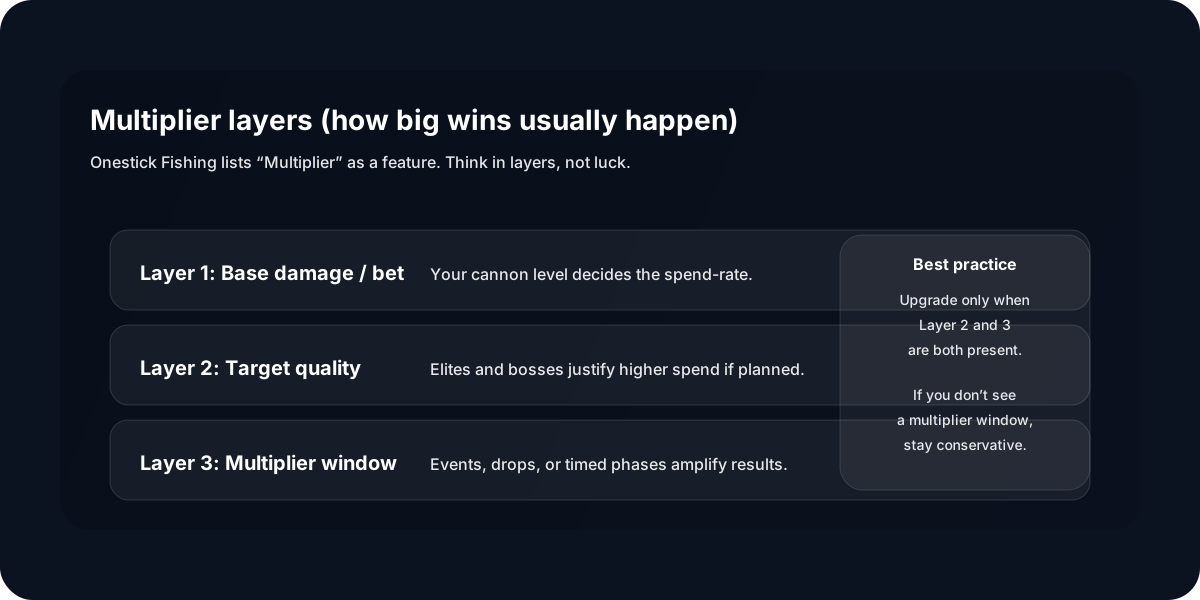
Premium play is not shooting everything at a high cannon. Premium play is increasing cannon level only when two things line up: (1) the target is clearly high value (elite/boss/event), and (2) the screen gives you a multiplier-like window or dense cluster that can justify higher spend.
The Monkey King theme as a gameplay cue
SlotCatalog describes the theme as Monkey King legend with demons and treasures. In many themed shooters, ‘demonic’ or ‘mythical’ creatures represent higher-risk, higher-reward targets. Treat them as scheduled attempts with a plan, not as background noise.
The simplest way to implement the cap-first method is to use a time cap. Choose a number you can follow without debate, such as 10–20 seconds. Start the attempt, focus fire, and if the time ends, you stop. Over time you can convert time caps into bullet caps once you understand your pace.
Targets and symbols: a practical classification
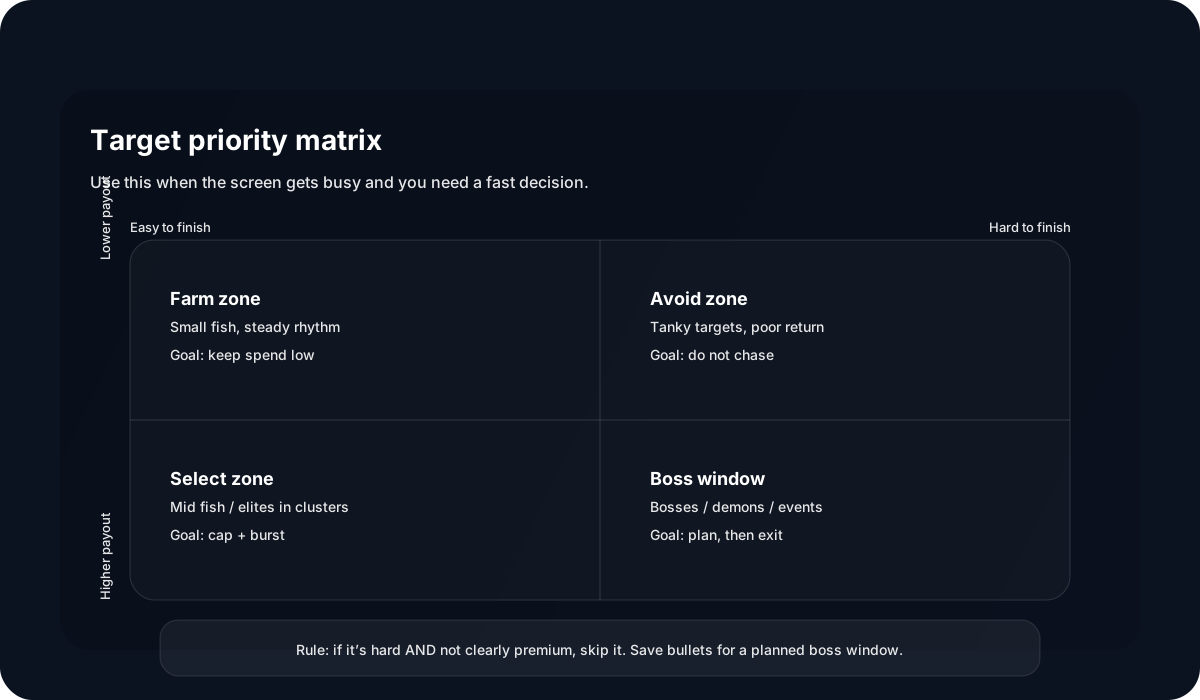
Fishing shooters often have many themed creatures and effects. Instead of memorizing names, classify targets by difficulty and by what they do to your budget. The table below gives a practical “band” system you can apply even if the visuals differ between versions.
Band 1 — Farm targets (low stress)
Examples: Small fish and slow swimmers that stay on-screen
Risk: Low. Returns are smaller, but spending stays predictable.
How to play it: Use your base cannon, fire short bursts, and prioritize center crossings. Your goal is to stay calm and keep hit-rate high. If you’re learning the UI, spend most of the session here.
Band 2 — Value targets (controlled upside)
Examples: Medium fish, clustered groups, targets that swim in arcs
Risk: Medium. These can drain you if you chase too long.
How to play it: Only attempt when you can keep the target in view. Set a cap and stop at the cap even if the target looks ‘nearly dead’. If you step up the cannon, do it for a timer (for example, 10 seconds) and then reset.
Band 3 — Elite targets (high variance)
Examples: Mythical creatures, armored fish, special-effect targets
Risk: High. The exciting part is also the costly part.
How to play it: Treat elites like mini-bosses. Decide the maximum you’re willing to spend on the attempt. Focus fire, keep the target centered, and do not chase off-screen. If the attempt fails, go back to farm targets to recover rhythm.
Band 4 — Boss targets and event phases
Examples: Boss demons, treasure events, limited-time phases
Risk: Very high. These windows can make or break a session.
How to play it: Make a boss plan: pick a short window, pick the cannon level, and set a hard cap. During the window, shoot only the boss (no distractions). When the window ends, exit instantly. The exit is part of the strategy.
If you’re unsure what you’re looking at on the screen, use a simple rule: assume it is expensive until proven otherwise. Test it with a small, capped attempt. If it drains you, you’ve learned something valuable without paying too much tuition.
Multipliers: how to approach the feature without tilting
SlotCatalog lists “Multiplier” as a feature in Onestick Fishing. In casino arcade games, multipliers are often the bridge between normal play and big moments. The risk is that they also create urgency. Urgency turns careful players into sprayers.
What ‘multiplier’ usually means in a fishing shooter
In shooting games, multipliers often appear as temporary effects: an event phase, a special target that boosts rewards, a time-limited mode, or a bonus that stacks with the base capture payout. You don’t need to know the exact internal math to play it well. You need to recognize that multipliers are time-limited and should be treated like planned windows.
Multiplier windows are where step-ups are justified
If you step up your cannon randomly, you simply spend faster. If you step up during a multiplier window, you may increase upside per bullet. That’s the disciplined approach: step up only when the screen is clearly premium. When the window ends, reset to base.
How to avoid the ‘multiplier trap’
A multiplier icon can cause impulsive play: players start spraying because it feels urgent. The fix is to use a tighter cap than normal. When the screen becomes premium, reduce the attempt length but increase focus. Short, focused attempts beat long, emotional chases.
Multiplier rule of thumb
During a premium window, do less, but do it better: pick one target, focus fire, and cap the attempt. If you try to shoot everything, you will reduce accuracy and waste the window. Precision is the multiplier you control.
Boss windows: disciplined high-variance play
Bosses and demon-like creatures are the emotional peak of fishing games. They’re also the part that can ruin an otherwise good session. The solution is to turn bosses into windows: a short plan with a defined beginning and end.
Bosses are timed events, not permanent objectives
A boss does not deserve infinite bullets just because it’s on-screen. Boss play should be a scheduled part of your session: enter with a plan, commit for a short window, and exit. If you can’t exit cleanly, you’re not playing a boss—you’re chasing a feeling.
The three boss rules that keep things safe
Rule 1: only attempt bosses when you are calm. Rule 2: during the window, shoot only the boss. Rule 3: when your cap ends (bullets or time), stop instantly. Following these three rules prevents almost all ‘spiral sessions’.
Boss positioning is everything
If the boss drifts toward an exit lane, stop firing and wait. A boss that is about to leave is a low-efficiency target. The best boss attempts happen when the boss stays near center, moves slowly, and the screen is not cluttered with distractions.
A practical way to schedule boss play is to place it after you’ve had a calm warm-up. If your first ten minutes were frantic, you’re not ready for a boss window. If your first ten minutes were calm and capped, a short boss attempt can be fun and controlled.
RTP and variance: what the numbers do (and don’t) mean
SlotCatalog lists Onestick Fishing RTP as 96%. RTP is a long-run statistical target, not a guarantee for tonight’s session. In a fishing shooter, variance can feel stronger than in a reel slot because you can spend much faster than “one spin per few seconds”. That’s why you must build structure: structure slows down the spend-rate and lets the RTP concept matter.
If you want a simple interpretation: your decisions are the steering wheel, and variance is the weather. You can’t control the weather, but you can choose whether to drive 120 km/h in the rain or 50 km/h with headlights on. Bullet caps, base cannon discipline, and planned windows are your headlights.
Responsible play reminder
Treat this as entertainment. Set time limits and budget limits. If you feel the urge to chase losses, stop the session. No guide can override emotional play.
Tips and tricks (practical, repeatable habits)
These tips are designed to be repeatable. If a tip requires perfect timing or “lucky intuition”, it’s not a good strategy. The best Onestick Fishing strategy is a small set of habits that you can follow when the screen is busy.
Pick a base cannon level you can hold for 20+ minutes
The most common mistake is choosing a level that feels fun for 60 seconds and stressful for 10 minutes. If you can’t sustain it calmly, it’s too high.
Use bullet caps like a professional: cap first, shoot second
Always decide the cap before you lock or focus a target. If you decide the cap mid-chase, you’ll move the goalposts.
Aim for screen time, not for ‘rarity’
A rare target that stays for one second is worse than a common target that stays for five. Screen time is the simplest edge.
Fire in bursts, not in panic
Bursts help you re-aim and prevent accidental overspending when targets leave the lane. Bursts also make your caps easier to track.
When the screen is empty, stop shooting
Empty screens bait players into firing ‘just in case’. It’s pure cost. Wait for a clean crossing.
Treat multipliers as a timer
If you see a premium phase, shorten your attempt window and increase focus. Your goal is to execute one clean attempt, not to shoot everything.
Do one step-up per window (max)
Stepping up repeatedly is a hidden tilt pattern. If you decide to step up, do it once, for a defined duration, then reset.
If the boss is exiting, don’t chase
Chasing an exiting boss is the fastest way to turn a controlled window into a loss. Pause and wait for a better setup.
Use the center lane as your default ‘shoot zone’
Shooting near the center naturally increases hit rate because targets have more time on-screen.
Rotate targets to avoid sunk-cost thinking
The moment you think ‘I’ve already spent too much to stop’, you should stop. Rotation breaks the sunk-cost loop.
Track your pace: bullets per minute matters
Two players with the same cannon level can have totally different outcomes because one fires continuously and the other fires only on good crossings. Slowing down is a strategy.
End sessions on time, not on emotion
Set a timer. If you keep playing until you ‘feel done’, you will usually stop after a bad chase, not after a clean plan.
Session templates
Templates remove decision fatigue. If you know what the session is supposed to be, you’re less likely to drift into random cannon increases. Pick one template and follow it fully before you mix strategies.
Warm-up and learn (beginner)
Duration
15–20 minutes
Goal
Learn controls + caps
Play at base cannon only. Shoot farm targets near center. Use a small cap (for example 10–20 seconds per target). Avoid bosses completely. The win condition is learning, not profit.
Multiplier hunting (structured)
Duration
20–30 minutes
Goal
Practice premium windows
Farm normally. When a multiplier-like event appears, take one planned attempt: step up once, focus one high-value target, and stop at a tight cap. Reset immediately after the window ends.
Boss-only micro session
Duration
10–15 minutes
Goal
Boss discipline
Spend the first half farming. Then schedule 1–2 boss windows only. Each window: decide cannon and cap before firing, focus boss only, exit at cap. If the boss exits early, you do not extend the window.
Low-drama entertainment session
Duration
30–45 minutes
Goal
Stay calm and consistent
Never exceed base cannon. Rotate targets quickly. Ignore bosses unless the screen is clean and the boss stays central. This template is for players who prefer a slower, steadier pace.
Mistakes that cost money (and how to fix them)
Raising cannon because you feel bored
Boredom is not a strategy. Cannon increases should be tied to a window (cluster/multiplier/boss), not to emotion.
Chasing targets as they exit the screen
Exiting targets reduce hit-rate. Reduced hit-rate turns a fair game into a losing loop. Wait for better screen time.
Using auto fire without a stop rule
Auto fire is fine if you have discipline. Without a stop rule it becomes hidden overspending, especially during empty screens.
Turning a boss into a personal grudge
Bosses do not ‘owe’ you a drop. If the cap ends, exit. Treat it like a timed event, not a duel.
Ignoring your pace
You can lose with a low cannon by firing constantly. Slow down. Fire only when a target gives you good odds of connecting.
Trying to learn everything in one session
A good learning session has one focus: aim, caps, or boss windows. Trying everything at once creates chaotic spending.
If you want one quick fix for most mistakes: slow down. Slower pace gives you time to re-aim, notice exits, and remember your cap. Speed is optional. Discipline is not.
Myths (beliefs that create bad sessions)
‘If I keep shooting, it must drop’
Truth: A target can resist longer than you expect. Outcomes are not guaranteed within your personal budget.
Fix: Use caps. If the cap ends, rotate immediately and wait for a better target or window.
‘Higher cannon always means higher profit’
Truth: Higher cannon increases burn rate. Without a premium window, you simply spend faster.
Fix: Tie step-ups to multiplier windows or clearly premium targets, and time-limit the step-up.
‘Bosses are the only way to win big’
Truth: Big wins often come from timing and stacking effects, not from mindless boss chasing.
Fix: Build a session around clean farming and one or two planned attempts, not nonstop boss play.
‘Auto fire is free efficiency’
Truth: Auto fire can be efficient, but it can also be a spending leak when targets leave the lane.
Fix: Auto only when the screen is dense and stable. Turn it off during transitions and empty screens.
‘Multipliers mean I should shoot everything’
Truth: Multipliers are a time window. Spraying lowers accuracy and drains the window.
Fix: Pick one target, focus fire, and use a tighter cap than normal. Precision beats panic.
‘I can win back losses if I raise the cannon’
Truth: Chasing by raising cannon is a classic tilt move and tends to accelerate losses.
Fix: Reset to base cannon. If you feel the urge to chase, end the session on time.
Onestick Fishing is best enjoyed with structure. Structure keeps it fun.
Play demo vs play real
Demo play is the best place to build habits: caps, pace, and clean boss windows. Demo availability can vary by region and network. This page provides a SlotCatalog demo link and a real-play link to 6 Club.
Playable demo
Onestick Fishing demo widget
If the demo is restricted on some networks/regions, the widget may not load. In that case, use the “Play Demo” link to open SlotCatalog directly.
Widget status
Loading
Source: SlotCatalog “Integrate demo game” snippet (FreeDemo widget). This page embeds it for convenience.
How to use demo correctly
In demo mode, don’t try to “win big”. Practice caps and exits. Choose a target, set a timer, and stop even if you feel close. If you can exit correctly in demo, you can exit correctly with real money.
Video
SlotCatalog hosts a “Video and Image gallery” section for Onestick Fishing. If you want additional footage and screenshots beyond what we saved locally, open the SlotCatalog page and scroll to the gallery.
If you want a specific video embedded directly here (for example, a YouTube embed), share the exact embeddable URL and we can add it without guessing.
FAQs
Is Onestick Fishing available on 6 Club?
Yes. Onestick Fishing appears under Our Games → Fishing on 6 Club. Availability can vary by region/platform, but the guide route and tile exist.
Is Onestick Fishing a slot or a shooting game?
It’s a shooting game (fishing shooter). It shares casino-style payout logic, but gameplay is interactive: you aim and shoot targets and get paid when they are captured.
What is the RTP of Onestick Fishing?
SlotCatalog lists Onestick Fishing RTP as 96%. RTP is a long-run concept; short sessions can swing a lot depending on decisions and variance.
What is the max win in Onestick Fishing?
SlotCatalog lists max win up to x1000. The best way to approach ‘big win’ potential is to plan premium windows (events/bosses) instead of increasing cannon randomly.
Does Onestick Fishing have multipliers?
SlotCatalog lists ‘Multiplier’ as a feature. In practice, treat multipliers as short windows: focus on one target, cap the attempt, then reset.
What is a safe bet-per-shot for beginners?
Start at the lowest level that still feels responsive. The goal is to play calmly for 20+ minutes while following bullet caps. If you feel rushed, the level is too high.
How do I avoid overspending?
Use three guardrails: a timer, a base cannon level, and a bullet cap per target. These three controls prevent nearly all tilt patterns in fishing shooters.
Is Onestick Fishing skill-based or luck-based?
Both. You can’t guarantee any single capture, but you control choices that strongly affect long-run outcomes: which targets you attempt, how long you chase them, your cannon level, and your pace.
Should I use auto fire?
Auto fire can help with steady farming, but it can also spend too much during empty screens or exit lanes. If you use it, build a stop rule and turn it off whenever the screen becomes unstable.
What’s the best way to approach bosses?
Schedule boss play. Pick a short time window, pick your cannon level, and set a cap. During the window, focus only the boss. When the window ends, exit even if you feel ‘close’.
Can I practice for free?
SlotCatalog presents a demo section for Onestick Fishing, but demo availability can vary by region and network. This page links to SlotCatalog for demo practice and also provides a real-play link to 6 Club.
Where do the numbers on this page come from?
Quick facts like RTP, release date, max win, and bet range are taken from the Onestick Fishing attributes table on SlotCatalog.
Images and visuals
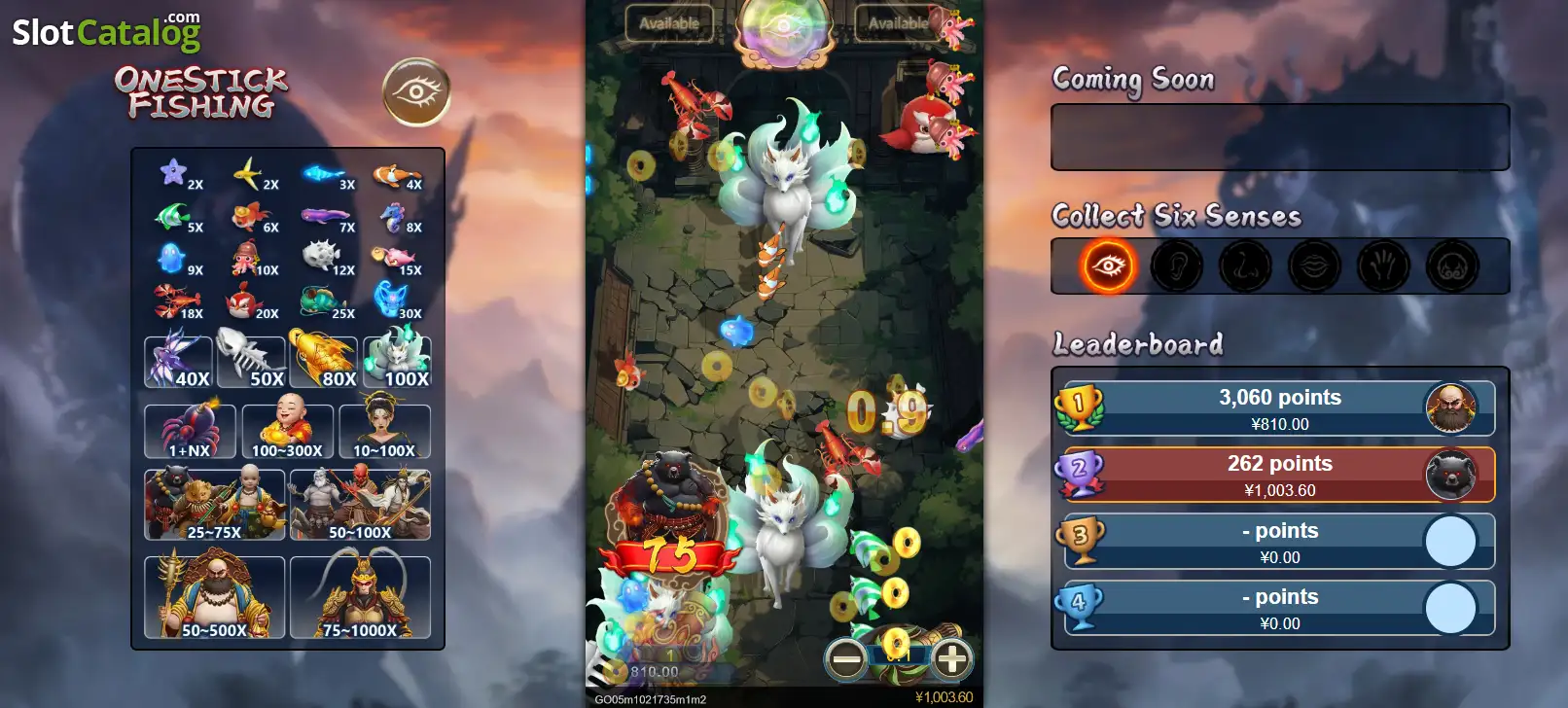
Below are original SVG diagrams made for this guide and selected screenshots from SlotCatalog’s gallery saved locally into the site’s public folder.



Ready to play?
Start with a base cannon, follow caps, and treat bosses as windows. That single structure keeps Onestick Fishing fun.